 Paul
Paul
During my time as a web developer and popular website owner there was one piece of the workflow that I dreaded more than almost any other, which was the design phase of any new feature or page. It wasn't that I had anything against designers, because the designers I worked with were genuinely talented, but rather that the cycle between having an idea and seeing a real working version of it was always slow, expensive, and full of friction in ways that quietly killed a lot of good ideas before they ever made it into production. So when Anthropic launched Claude Design a few weeks ago, I sat down with it expecting to be mildly impressed and ended up genuinely shocked.
I want to write about Claude Design with both eyes open, because the tool is genuinely a game changer for solo founders like me but also has real downsides, and there's a bigger conversation about what this means for the design profession that I think gets glossed over when everyone is busy celebrating a new product. So this post is going to cover all three sides of that, starting with what's actually impressive about it.
Why I no longer need Figma
Figma has been the default for design work for years now, and for good reason, because it's a deeply capable tool that handles the entire workflow from low-fidelity wireframes to production-ready handoffs, and it does it with a level of polish that no competitor ever quite matched. The problem with Figma for me was never that the tool wasn't good but rather that it required me to actually be a designer to get anything useful out of it. I used to be a good graphics designer but my skills deteriorated after running a popular website and delegating all the designs to staff members. So when I'd open a blank canvas, spend twenty minutes pushing rectangles around, end up with something that looked like a 1998 Geocities page, get frustrated, and either pay someone to do it or just ship with the tell-tale Claude Code design (hello Inter font).
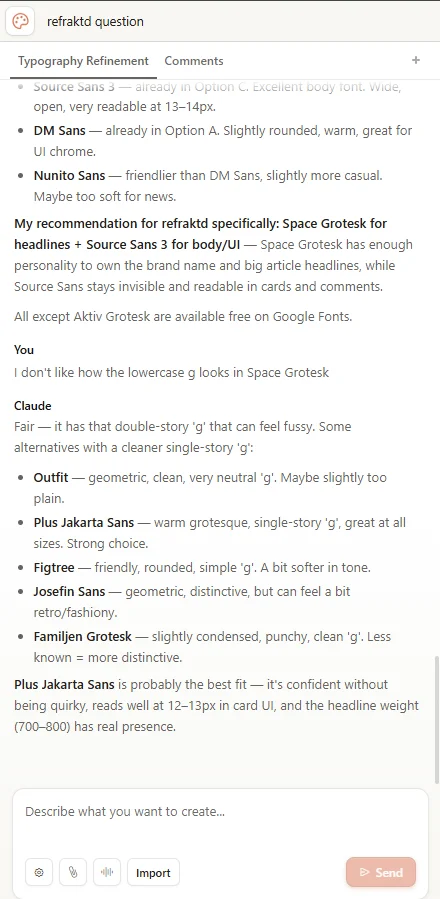
Claude Design changes that whole equation by letting me describe what I want in plain language and getting back something that's actually professionally designed on the first pass, and then refining it through conversation rather than through manual manipulation of design primitives. The interface is split into a chat window on the left and a live canvas on the right, where you describe what you want, watch the design appear in real time, and refine it either through more conversation or by clicking directly on individual components and leaving inline comments. I described a landing page for one of my platforms, told it the brand colors and the rough vibe I was going for, and got back a polished page with proper typography, sensible spacing, real interactive elements, and a hero section that didn't look like it was made by someone who has never opened Figma. Then I refined it for another twenty minutes through small conversational adjustments, and what I ended up with would have taken me a weekend to produce in Figma even if I'd been willing to suffer through it.
One of the features that genuinely surprised me is that Claude Design can read your existing codebase during setup and pull out your actual design tokens, colors, typography, and component patterns, then apply that system automatically to every design it generates afterward. This is meaningfully different from uploading a Figma file and hoping the AI matches the style, because Claude is reading your real design language at the code level rather than approximating it from a static image, and the consistency you get across multiple designs is the kind of thing that used to require a designer to manually enforce on every project. For solo founders running a portfolio of platforms, that single feature alone collapses hours of work per project.
The other feature worth mentioning is the web capture tool, which lets you grab elements directly from an existing website and use them as references for new designs, so prototypes can actually look like extensions of your real product rather than generic mockups. And when you want to explore alternatives, you can ask Claude to generate three variations of the same screen and keep all of them accessible, then mix pieces from different versions into the final design, which is the kind of workflow that took ages to do manually in Figma.
The piece that impressed me the most was the handoff to Claude Code, where Claude Design packages up the design with all the context Claude Code needs to actually implement it, and I went from "I wish I had a designed landing page" to "I have a deployed designed landing page" in less than two hours of total work. You can also export designs as HTML for working prototypes, as PDF or PPTX for stakeholder presentations, as ZIP files for engineers to code from, or send them to Canva for marketing assets, which means the design isn't a dead artifact at the end of a process but rather a starting point for whatever comes next. That's not a faster workflow than Figma, that's a different category of workflow entirely, and once you've experienced it you can't really go back to the old way without feeling like you're wasting time on purpose.
For solo founders and non-designers who've been using Figma reluctantly because it was the only option, Claude Design genuinely replaces it for most of the work that matters. I'm sure there are still cases where a senior designer with deep Figma muscle memory can do things in Figma that Claude Design can't quite handle, but for the kind of work I do, which is rapid landing pages, marketing assets, and product mockups for platforms I'm building from scratch, I don't have to use Figma.
The rate limit problem
This is the part of the post where I have to be honest about what's actually frustrating, because the launch coverage isn't going to mention it and I think it's important enough to flag clearly. Claude Design has its own Claude subscription limit tier, which sounds reasonable on paper, but in practice the design work eats through those limits much faster than regular text-based Claude usage, and I hit the weekly cap on my plan within a few days of starting to use the tool seriously. Each iteration on a design appears to consume meaningfully more of your weekly allowance compared to the weekly allowance for regular Claude usage, which makes sense given the visual generation work involved, but the real-world result is that a single afternoon of focused design work can burn through capacity that would have lasted me a full week of normal coding.
The other issue is that the rhythm of design work is different from coding work, where you tend to do intense bursts during a launch and then very little in between, and the weekly limit structure penalizes exactly that pattern. You can't bank unused capacity from a quiet week to spend during a launch sprint, you can't pre-purchase a credit pack for a specific project, and you can't easily predict in advance how much capacity a given project will consume, so you end up either rationing yourself defensively or paying overage fees that feel disconnected from what you're actually getting. For someone running a portfolio of platforms on a tight budget, the math gets uncomfortable enough that I find myself reaching for older tools when I'd rather be using Claude Design, which defeats part of the point of having such a fast iteration tool in the first place.
The honest read is that the pricing model isn't quite right for the way solo founders actually work, and I'd love to see something like a higher per-week ceiling for Claude Design specifically, or a clearer signal of how much capacity any given action will consume so you can plan around it. The tool is good enough that I'll keep using it within whatever constraints exist, but the constraints are real and worth being honest about, because the launch posts aren't going to be.
The other thing that compounds the rate limit problem is that Claude Design doesn't always follow instructions on the first try, or even the second or third, and the iterations you spend trying to get it to actually do what you asked are iterations that count against your weekly limit just like the productive ones. You'll prompt it to change a specific element in a specific way, watch it change something else entirely or apply the change inconsistently across the design, then tighten the prompt to be more explicit and specific about what you want, and watch it ignore the new instructions in a slightly different way. Sometimes you'll go four or five rounds of increasingly precise prompts before either getting what you originally asked for or giving up and editing it manually, and every one of those rounds is burning through capacity you didn't expect to spend. The frustrating part isn't that the tool makes mistakes, because every AI tool makes mistakes, but rather that the failure mode is silent token burn rather than an obvious error you could work around, and you can lose half a session to prompt-tuning that wouldn't have been necessary if the model had just followed clear instructions the first time.
What this means for designers
I want to talk about the harder topic now, because there's an obvious question hanging over any tool like this that the launch posts always seem to dance around, which is what happens to the designers whose work this tool can now do at a fraction of the cost and time. I don't think the answer is "designers are cooked," because that's lazy and wrong, but I also don't think the answer is "nothing changes," which is the polite fiction that the announcements tend to imply.
The honest middle position is that Claude Design eats a specific layer of design work that used to be a meaningful chunk of what designers got paid to do, particularly the early-stage exploration, the rapid prototyping, the marketing collateral, and the standard landing page work that used to take a designer a few days to produce. That layer is now largely automatable for non-designers like me, and it's going to be even more automatable for actual designers who can use Claude Design as a force multiplier on their own skills rather than as a replacement for them. So the work doesn't disappear, but the price for that specific category of work collapses, which means designers who were earning their living mostly on that layer are going to find their billable hours getting harder to justify.
What doesn't go away is the strategic design work, the brand systems, the genuinely complex interaction design, and the craft-level polish that distinguishes a good product from a great one, because Claude Design produces output that's solidly in the "good enough" range but not the kind of work that wins design awards or moves the needle on a serious product. Designers who've built their careers on that higher level are probably fine, and might even benefit from being freed up to focus on the work where their judgment actually matters, since the rote production work that used to fill their schedules can now be handled by founders directly. There's a broader movement people are calling vibe design, where the practice shifts from operating tools to articulating intent, and the designers who lean into that shift are positioned to do more interesting work, not less.
The designers who are going to feel real pain are the ones who built their practice around the rote production layer, where you're charging for execution rather than for taste or strategy, because that layer is the one Claude Design absorbs most cleanly. There's entire jobs on Figma design or Figma UX design and Claude Design can erase that overnight. If your portfolio is mostly landing pages, social media graphics, and basic product mockups, the price structure for that work is going to drop significantly over the next year or two, and the answer probably isn't to compete on price but rather to move up the value chain into the work that still requires real design judgment. That's hard advice to give and harder to receive, especially for designers who are early in their careers and haven't had the time to develop the higher-order skills yet, and I don't have a clean answer for what happens to those folks except to acknowledge that this is a real disruption that deserves more honest conversation than it's getting.
The pattern here is the same one we're seeing across other knowledge work that AI tools are reshaping, where the rote layer collapses, the strategic layer becomes more valuable, and the people in the middle either move up or move out. That's not a comfortable reality but it's the actual reality, and pretending otherwise doesn't help anyone navigate it.
What I'd recommend
For solo founders and non-designers building their own platforms, you should absolutely try Claude Design as soon as you can, because it's the closest thing to having a designer on your team that exists for someone working alone, and the productivity gain on design-adjacent work is the largest single workflow improvement I've experienced since Claude Code itself. Just be aware of the rate limit situation and plan your usage in bursts that fit within the weekly windows, or budget for the extra usage costs if you're going to be doing serious design work in any given week.
For designers reading this, the practical advice is to use Claude Design yourself as a force multiplier on your existing skills rather than treating it as a competitor or pretending it doesn't exist, because the designers who adopt these tools first are going to be the ones who keep their pricing power and do more at a faster rate. The designers who refuse to engage with the tools and try to compete on the old terms are going to lose ground steadily, and that's not a moral judgment but just the way these technology shifts have always played out historically. Figma isn't going away either, so the actual question isn't "Claude Design or Figma" but rather "which tool is right for which problem in my workflow," and the honest answer is that Claude Design is faster for ideation and prototyping while Figma still wins for design systems and long-term collaboration on mature products.
For Anthropic, if anyone from the team is reading this, the rate limit structure is the single biggest issue with the product right now from my perspective as a paying customer, and I'd love to see a model that better matches how this kind of intensive iterative work actually happens.
Claude Design is genuinely a game changer for the kind of work I do, and I'm going to keep using it for as long as the economics make sense, but the honest version of this post needs to include both the part where I'm impressed and the parts where I'm worried, because that's how you actually evaluate a new tool rather than just adding to the chorus of launch celebrations. The product is excellent, the limits are frustrating, and the broader implications for designers deserve more conversation than they're getting, all at the same time.