 Paul
Paul
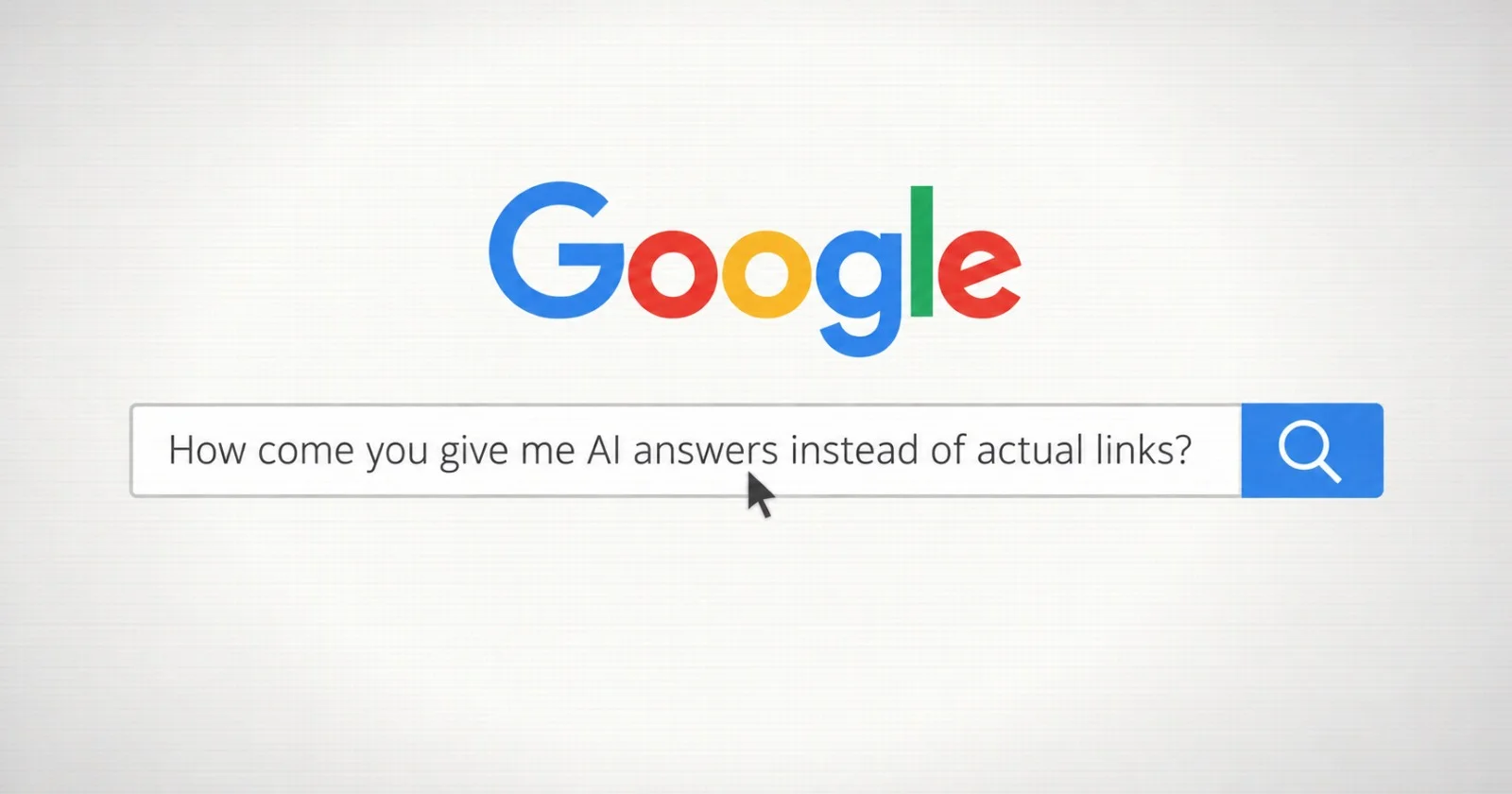
There's a crisis happening in the world of people who make things on the internet, and if you run any kind of content site you've probably already felt it even if you haven't fully named it. Google's AI Overviews, the AI-generated summaries that now sit at the top of a huge share of search results, are absorbing the hard work that publishers and creators do and answering the user's question directly on the results page, which means the user never clicks through to the site that actually produced the information. The summary is the destination now, and the websites that fed it are increasingly an afterthought. I want to walk through why this is a bigger problem than it looks, where it logically leads, and the uncomfortable question underneath all of it, which is whether one company should have this much control over the entire system.
I'm coming at this as someone who has built content sites for a long time and has real skin in the game, so I'm not a neutral observer here. But the data on this is strong enough that you don't have to take my word for any of it, and the trend is alarming enough that it deserves to be talked about plainly rather than buried in the polite language the industry tends to use.
The numbers are genuinely brutal
Let's start with what's actually happening, because the scale of it is easy to underestimate if you haven't looked at the data. An Ahrefs study from early 2026 found that AI Overviews correlate with a 58 percent reduction in click-through rates for the top-ranking page, which means being number one on Google, the coveted position everyone spends years fighting for, now delivers less than half the clicks it used to when an AI Overview sits above it. Pew Research found that when an AI Overview is present, only about 8 percent of users click a traditional search result, compared to 15 percent when there's no overview, so the overview roughly halves the click rate on its own.
Zoom out and it gets worse. Something like 60 percent of Google searches now end with zero clicks to any website at all, and for queries where an AI Overview appears, that zero-click rate climbs to somewhere around 80 percent. The user asked, Google answered, and the website that the answer came from never saw the visitor. People in the industry have started calling this the Great Decoupling, where your impressions stay flat or even rise while your actual clicks fall off a cliff, so Google's data shows your content being shown to more people than ever while you get less and less traffic from it. You're more visible and less visited at the same time, which is a genuinely strange and bad place to be.
This isn't a small adjustment. Major publishers have reported traffic declines ranging from modest to catastrophic, with some specific search categories seeing drops approaching 90 percent. This is a structural change to the economics that have funded online content for two decades, not a temporary dip while everyone adjusts.
Why this kills the incentive to make good things
Here's the part that I think gets underdiscussed, because everyone focuses on the immediate traffic loss and misses the longer-term logic. The entire deal that built the modern web was simple and mostly unspoken: you make good content, Google indexes it, and in exchange Google sends you visitors. That referral traffic is what paid for the content, whether through ads, subscriptions, product sales, or just the attention that made the work worth doing. The traffic was the payment, and the payment is what made people keep producing.
AI Overviews supplanted everything and breaks that deal. If Google takes your content, summarizes it, answers the user's question, and keeps the visitor on Google's own page, then you did the work and Google captured the value. And once creators internalize that making great content just feeds a machine that will absorb it and give nothing back, the rational response is to stop making great content. Why would you spend days researching and writing a genuinely useful guide if the predictable outcome is that an AI Overview lifts the substance of it, shows it to the searcher, and sends you nothing? The incentive that powered the whole system, the expectation of getting traffic in return for effort, is exactly what AI Overviews remove.
This is the trap, and it's a slow one. It doesn't happen all at once. It happens as creators quietly do the math, conclude the effort no longer pays, and either lower their effort or stop entirely. The great content doesn't disappear in a dramatic collapse, it just slowly stops being made, because the people who would have made it can no longer justify the time to do so. And the cruel irony is that AI Overviews depend entirely on that content existing in order to have anything to summarize, so the feature is systematically destroying the thing it runs on.
Where this most likely ends up
Follow that logic forward and you get somewhere genuinely strange. If the supply of fresh, human-made content shrinks because the incentive to make it has been removed, then at some point the AI systems that depend on that content start running out of new material to summarize. The well they're drinking from is the open web, and they're draining it faster than it refills.
What happens then is the interesting question. One possibility is that the AI companies, having disincentivized the humans who used to fill the gaps, end up having to discover and generate the content themselves to keep their systems fed. You'd have AI generating the content that AI then summarizes, a closed loop with the humans pushed out of the middle, which is a deeply weird outcome and probably a worse one for everybody, because human-made content has a groundedness and a connection to reality that AI content struggles to capture. The risk is a kind of slow degradation, where the information ecosystem gets less and less connected to actual human knowledge and experience over time as the people who provided that connection stop participating.
I don't think we're at that endpoint yet, and it's possible something intervenes before we get there, whether that's regulation, a change in how the AI systems compensate creators, or a market correction that nobody's predicted. But the direction of the incentives right now points that way, and the direction matters even if the destination is uncertain. When you remove the reward for making something, you get less of it, and that simple fact applied to the entire open web is a frightening thing to sit with.
The single point of failure problem
Separate from the AI Overviews issue, but related to it, is a thing that anyone running a content site already knows in their bones: Google can make one algorithm change and your business effectively disappears overnight. You can spend years building a site, doing everything right, ranking well, building real traffic, meeting the E-E-A-T guidelines, and then one update lands and your visibility evaporates with no warning, no explanation you can act on, and no recourse. Your entire livelihood can hinge on decisions made inside one company that you have no insight into and no influence over.
This was always a risk, but AI Overviews make it sharper, because now Google isn't just deciding where you rank, it's deciding whether the user even needs to leave Google at all. The company controls whether you're visible, and increasingly it controls whether visibility even translates into visitors. Building a business on top of Google search has always meant building on someone else's land, but the terms of that arrangement keep shifting in one direction, and the party whose land it is keeps capturing more of the value while the tenants get kicked out.
I was a fan of Google
I want to be honest about where I'm coming from, because I'm not someone who ever hated Google. It's the opposite as I was actually a big fan of Google. I remember discovering Google as a kid and switching over from WebCrawler and Yahoo, not because it was trendy but because it was genuinely better, you typed something in and it actually found what you wanted. I thought something similar to PageRank was something that should've been built but I was a kid without the technical ability to create it but Google came out and solved it. I was one of the early ones to get a Gmail beta invite back when that was a thing people wanted and people were selling Gmail invites on eBay. I even remember defending Android in Android versus iOS arguments. Yes, I was a fan. A real one. And I think that's exactly why the current version of Google bothers me as much as it does, because I watched the priorities shift somewhere after the IPO, where the priority shifted from human to money. From building things that were good for people to extracting as much as possible from them, and the company that won me over by being better for users is now winning by being worse for the people who helped it so much.
The monopoly question
All of this leads to the question that's getting harder to avoid, which is whether Google simply has too much power over this entire system. Look at what one company controls. It runs the dominant search engine, so it decides what gets found. It runs the dominant web analytics, so it sees how everyone's traffic flows. It now runs the AI Overviews that sit on top of search and absorb the clicks. And it controls the dominant advertisement stack, so it sits on both sides of the advertising market that funds a huge share of online content. That's an enormous amount of control over discovery, measurement, monetization, and now the direct answering of questions, all concentrated in one company.
The legal system is starting to engage with this. Major publishers have filed antitrust action over AI Overviews specifically, with one large publishing group arguing in federal court that Google is cannibalizing publisher traffic, and European publishers have filed formal complaints with regulators. The core argument in these filings is that the long-standing arrangement, where publishers provide content in exchange for referral traffic, has been broken by a company powerful enough to take the content and keep the traffic, and that this is an abuse of a dominant position rather than just ordinary competition. I'm not a lawyer and I won't pretend to know how the cases resolve, but the fact that serious players are making this argument in court tells you the concern isn't fringe.
The thing that makes the monopoly question feel real to me, separate from the legal specifics, is the lack of an alternative for publishers. If you don't like how Google treats your content, where do you even go? There's Bing and DuckDuckGo but they're very small in comparison to Google. There's no meaningful second option that delivers comparable traffic, which means publishers don't really have the ability to walk away for a viable alternative, which is exactly the situation that market power is supposed to be checked against. When the dominant player can change the deal unilaterally and the other side has nowhere else to go, that's the shape of a problem regardless of how any particular lawsuit comes out.
Don't Be Evil
For fairness, let's look at the viewpoint that includes the other side. Google would argue, with some merit, that AI Overviews are what users actually want, that people prefer getting their answer immediately rather than clicking through three sites to assemble it themselves, and that serving users well is the whole point. There may be some truth in that. Maybe Google's internal metrics show that users like the overviews, and a company isn't obligated to preserve a business model just because publishers got used to it. Google has also started making changes, like adding links within overviews meant to send traffic back out, which is at least an acknowledgment that the relationship has a problem even if the fixes are modest so far.
But I keep coming back to the incentive problem, because that's the part that doesn't get solved by Google metrics showing that users like the feature. Even if users love AI Overviews, the long-term consequence of removing the reward for making content is less content, and a search engine with nothing good to surface serves users worse off in the end. The thing that's good for users this quarter may be quietly destroying the thing that makes the whole system valuable over the next decade, and the company best positioned to see that coming is also the one with the least incentive to slow down, because the clicks it's capturing are worth a fortune right now.
For those of us who build, the practical takeaway is uncomfortable but clear. Relying entirely on Google search traffic was always building on rented land, and the rent is going up while all the protections are going down. The defensible move is to build traffic sources you actually own, direct audiences, email lists, communities, the channels that don't depend on a single company's algorithm deciding whether your entire business model evaporates this month. That's harder and slower than ranking on Google, but it's the only version of this where you're not one algorithm change away from disappearing. The open web that rewarded good content with traffic was a genuinely good system, and the one that I enjoyed using. Now, watching it get hollowed out by the company that benefited most from it all is a hard thing to accept, but the builders who survive it are going to be the ones who saw the shift early and stopped depending on a deal that's already breaking. Google used to run on the motto "Don't be evil," back when they were the small player throwing rocks at the entrenched corporate machine. The motto is gone now, and it's not hard to see why, because you can't keep a motto like that on the wall once you've become the exact thing it was meant to keep you from becoming. There's a real irony here where Google asks publishers to post "helpful content" and it's time Google went back to their roots and be "helpful" to the same publishers that helped them become what they are today.
Sources
The 58 percent click-through-rate reduction on top-ranking pages comes from an Ahrefs study published in February 2026, reported in The Next Web's coverage of Google's AI Overviews updates and the publisher click decline.
The Pew Research finding that users click a traditional result 8 percent of the time when an AI Overview is present versus 15 percent when it is not is cited in SEO Kreativ's breakdown of the 2026 AI Overviews studies and Google's response.
The roughly 60 percent zero-click figure, the 80 percent-plus zero-click rate when an AI Overview is present, and the "Great Decoupling" framing of rising impressions against falling clicks are documented in Velacore's analysis of AI Overview traffic loss.
Publisher traffic declines, including the categories seeing drops approaching 90 percent, are reported in Search Engine Journal's coverage of the impact of AI Overviews on publishers and SmartFrame's report on the Google AI traffic drop.
The Penske Media Corporation antitrust filing alleging that Google is cannibalizing publisher traffic through AI Overviews is detailed in ALM Corp's analysis of the antitrust lawsuit and the 58 percent click decline. The European Publishers Council complaint and the broader publisher response are covered in the same Next Web and SEO Kreativ pieces linked above.
Note that these studies use different methodologies and measure slightly different things, so the figures are directional rather than perfectly comparable, and the exact numbers will continue to shift as AI Overviews evolve and as Google adjusts the feature. Verify current figures before relying on any specific number, and treat this post as a snapshot of where things stood at the time of writing.