
Anthropic just dropped Claude Sonnet 5 today, and if you build with these tools you should care about this one more than the usual model bump. Quick TLDR: it's the new default model, it's the most agentic Sonnet they've made, it gets close to Opus 4.8 on quality, and it costs a fraction of what Opus does.
This lands the same day as the announcement, June 30, 2026, and unlike some releases it's just available, right now, everywhere. Free, Pro, Max, Team, Enterprise, the API, and Claude Code. The API model string is claude-sonnet-5 if you're wiring it into something.
What's actually new
Anthropic is calling it “the most agentic Sonnet model yet.” This isn't being sold as a better chatbot, it's being sold as a better doer. It makes plans, uses tools like browsers and terminals, and runs autonomously through multi-step work. The pitch is that it finishes complex tasks where older Sonnet models would stop short, and the detail that caught my eye is that partners say it checks its own output without being told to. If you've ever watched an agent confidently hand you broken work, you know why self-checking is a big deal.
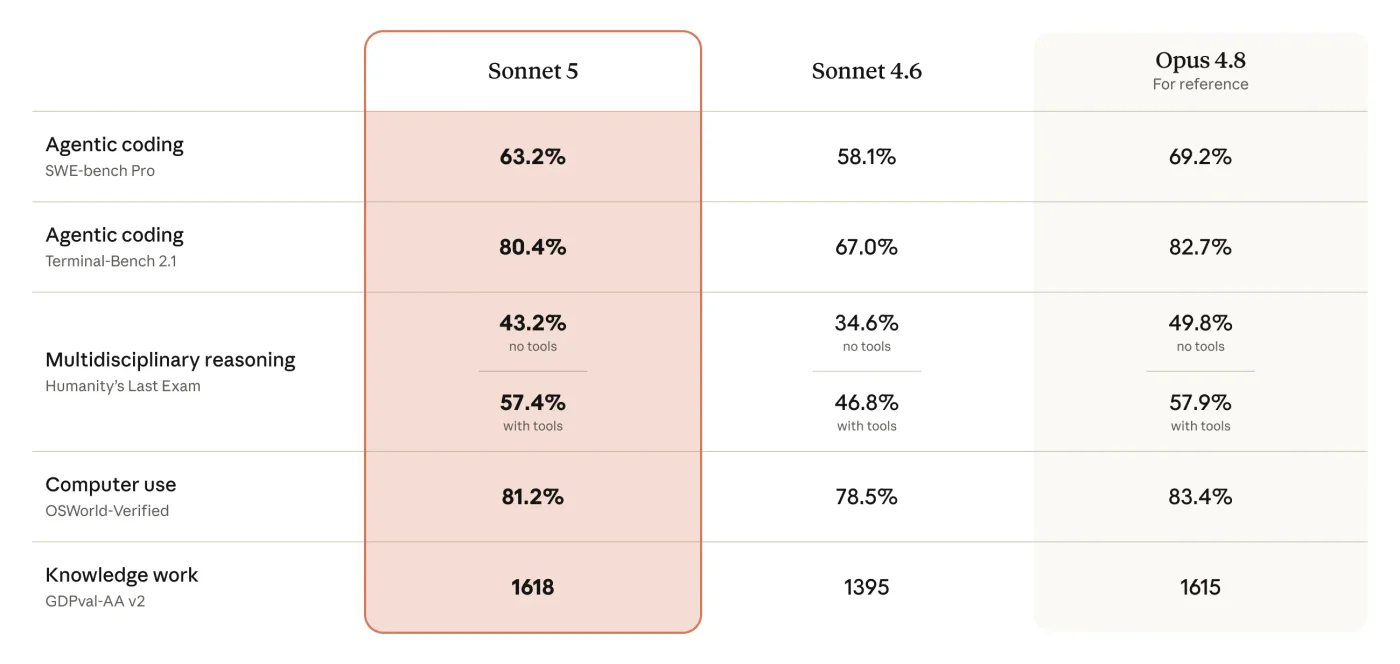
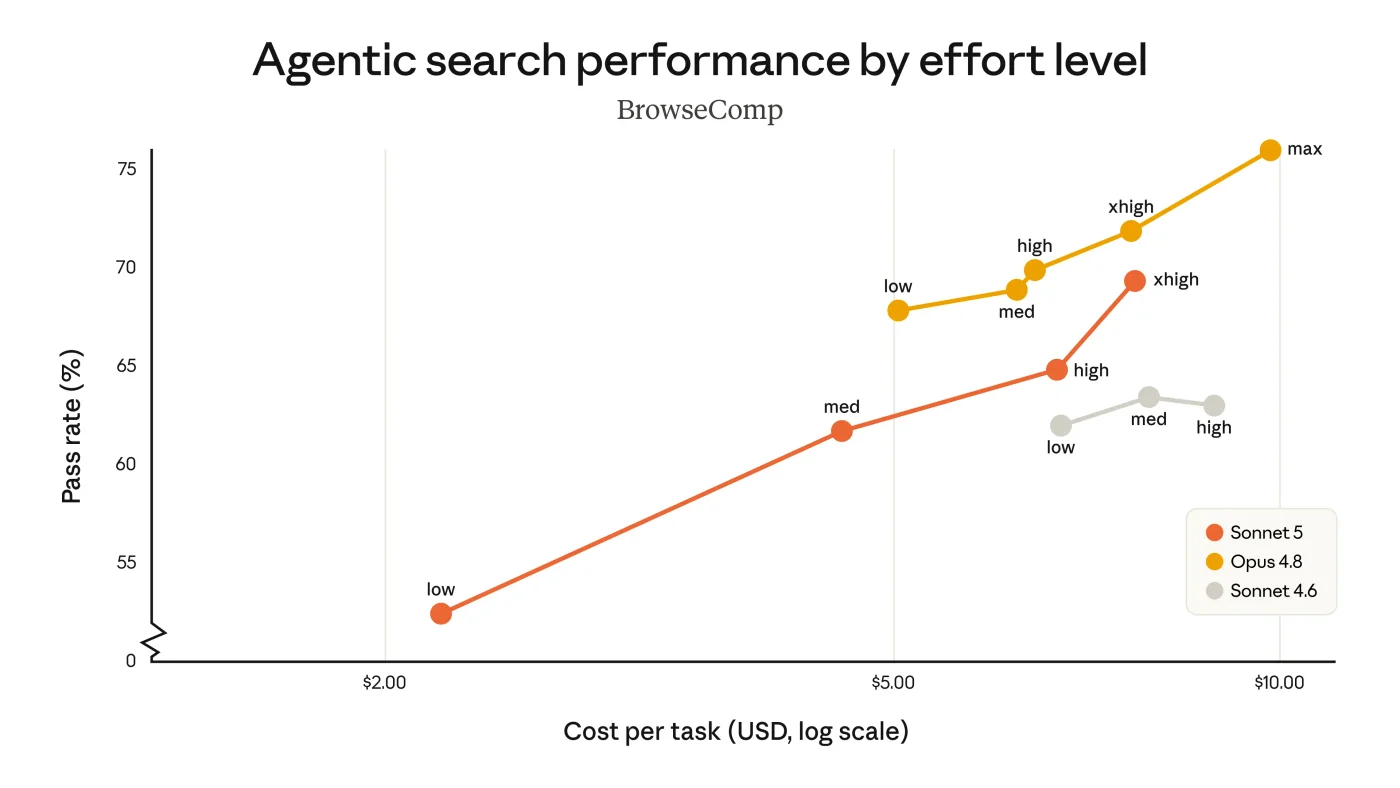
On the agentic evaluations Anthropic highlights, BrowseComp for agentic search and OSWorld-Verified for computer use, they say Sonnet 5 is a strict improvement over Sonnet 4.6, with cost-performance creeping up toward Opus 4.8. The full benchmark table on their page stacks Sonnet 5 against Sonnet 4.6 and Opus 4.8 across reasoning, tool use, coding, and knowledge work, and the short read is up across the board versus the Sonnet it replaces.
The price
Sonnet 5 launches with introductory pricing of two dollars per million input tokens and ten dollars per million output, running through August 31, 2026. After that it settles at three dollars input and fifteen output per million. Hold that next to the positioning, performance close to Opus 4.8, and you see what they're doing. They're handing you most of the top-tier capability at Sonnet money.
This matters most if you live in agentic coding, because that's the workload that burns tokens like crazy. A single agent task can chew through hundreds of thousands to millions of tokens, so the per-token rate isn't a rounding error, it's your whole bill. A model that gets near-Opus results while costing well under Opus rates is exactly the lever heavy users have been waiting for. If you've been rationing the expensive models for your gnarliest problems, Sonnet 5 widens the range of stuff you can throw a strong model at without wincing. For the full breakdown of what the plans and API actually cost, we already wrote the cost guide.
It's the new default
Sonnet 5 is now the default model on Free and Pro, which means most people are about to be using it whether they went looking for it or not. That's a real statement of confidence, since the default is what millions of casual users experience as "Claude." It's also available on every paid tier and through Claude Code, so there's no weird gating like we saw with the Fable launch where the model left the included plans after a few weeks.
Opus 4.8 is still the heavyweight, Fable 5 is the spicy Mythos-class option that burns your plan twice as fast and is currently not allowed to users, and Sonnet 5 is now the do-everything middle that's suddenly close enough to the top that the gap is small for a lot of real work.
The safety angle, because there's always one
Anthropic says Sonnet 5 has an overall lower rate of undesirable behaviors than Sonnet 4.6 and is safer in agentic contexts, which is the right direction for a model built to run on its own. The interesting bit is the cyber stuff. They're explicit that Sonnet 5 has substantially poorer cybersecurity capabilities than the Opus models, and it launched with cyber safeguards on by default. As one data point they share, Sonnet 5 and Sonnet 4.6 both scored zero on actually developing working Firefox exploits.
After the Fable 5 filters were blocking people for asking about sunglasses, the obvious question is whether these safeguards trip over normal defensive work the way Fable's did. The framing here is different, this reads more like a deliberately weaker capability than an aggressive classifier bolted on top, but it's worth watching once people put it through real security tasks.
So should you care
For most people, yes, and you don't have to do anything, since it's the default now. For builders the move is the same tiering logic that always wins: let Sonnet 5 carry the bulk of your agentic and coding work now that it's this strong and this cheap, and save Opus or Fable for the genuinely hard multi-step problems where the extra capability earns its price. It's the same argument we made about routing work across model tiers, except now the strong tier in that equation got a lot cheaper.
The bigger picture is that "good enough to be your daily driver" keeps getting cheaper, and the gap between the flagship and the workhorse keeps shrinking. A year ago, near-flagship quality at this price would have been a flagship announcement. Today it's a Tuesday. That trend is the actual headline, and it's a good one if you're the person paying the bill.
Sources
Anthropic: Introducing Claude Sonnet 5 - The June 30, 2026 announcement covering Sonnet 5 as the most agentic Sonnet model, its positioning close to Opus 4.8, the claude-sonnet-5 API model ID, default-model status on Free and Pro, the introductory pricing of $2 per million input and $10 per million output through August 31, 2026 before settling at $3 and $15, the strict improvement over Sonnet 4.6 on BrowseComp and OSWorld-Verified, and the safety notes including weaker cybersecurity capabilities, default cyber safeguards, and the zero scores on Firefox exploit development.