
You know the feeling. You're reading a Reddit thread and every reply has the same shape and format, the em dashes, the “That's Fair” and “Honestly” responses. You scroll Twitter and half the quote tweets read like they came off the same assembly line. Your uncle shares a chart on Facebook that looks like AI slop, has incorrect data, and measures nothing. All posted by a Facebook page that didn't exist last month, and forty thousand people are now arguing about it. And somewhere in the middle of all that scrolling a quiet thought shows up: "am I actually talking to people anymore?"
Here is my attempt to explain why the whole internet suddenly feels synthetic, not just one platform, and what that's actually doing to us.
Your gut already passed the fact check
First, let's look the receipts. We dug into the bot numbers on Twitter and Reddit a couple weeks back and they're worse than most people assume: bots now make up over half of global web traffic, a huge share of X accounts aren't people, and researchers have successfully run AI personas on real Reddit communities for months without anyone noticing. We did the same exercise for the Facebook slop economy, where content farms pump out fake charts and impossible cakes because the algorithm pays engagement like a slot machine pays triple cherries.
So the platform-by-platform question is answered. But that's not really the question anymore, is it? The new question is why it's everywhere at once. Reddit, Twitter, Facebook, LinkedIn, YouTube comments, product reviews, news articles, recipe blogs, the marketing email in your inbox. The synthetic feeling stopped being a platform problem and became the water we swim in.
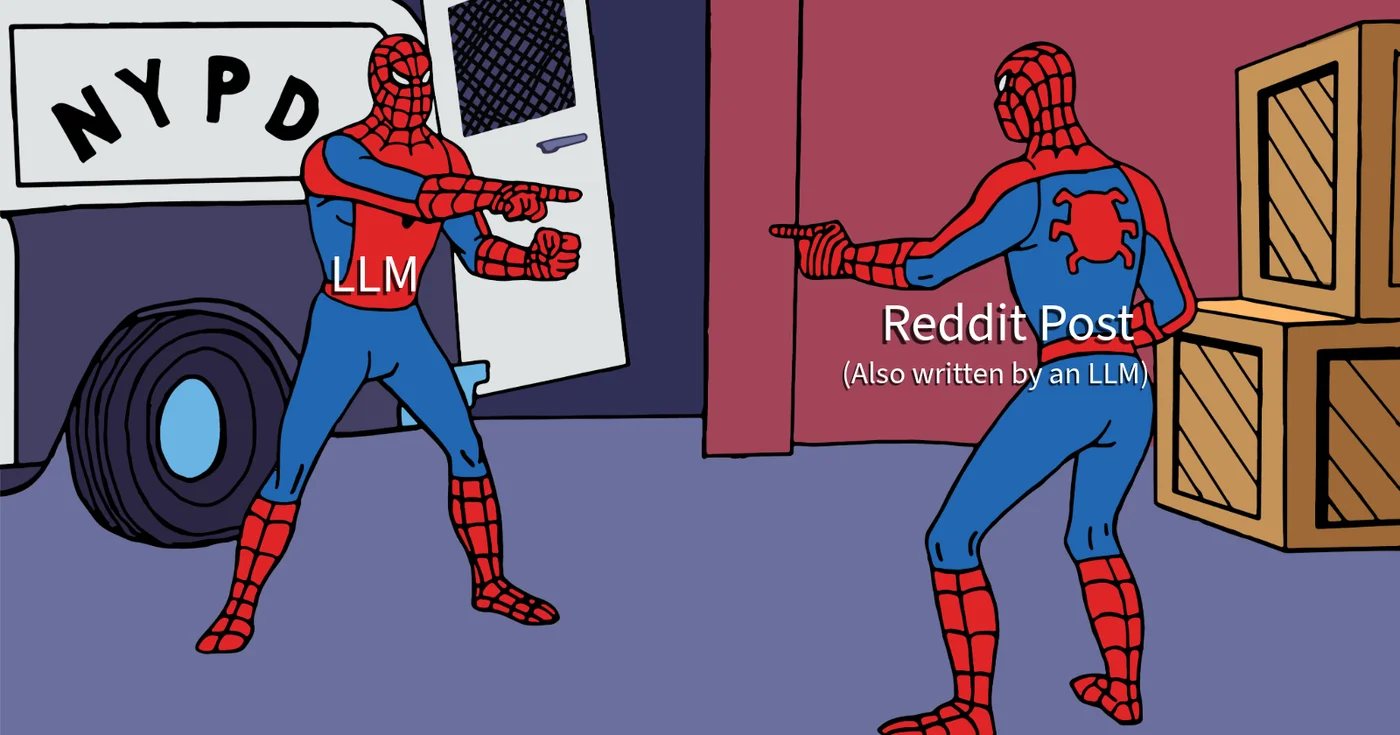
It's not just bots. It's also humans wearing an AI voice.
Here's a layer that I think actually explains the feeling, because bots alone don't cover it. A massive amount of what you're reading is posted by real humans who ran their words through an LLM first. The Redditor who pasted your question into ChatGPT and pasted the answer back. The LinkedIn guy whose every post now opens with a one-line hook and closes with a tidy lesson. The customer support reply that's technically responsive and emotionally vacant. There's a person behind every one of those accounts. The voice is rented though.
And this is the part nobody warned us about: when millions of people borrow the same voice, everyone starts sounding like the same nobody. The quirks sand off. The weird phrasing, the typos, the half-formed thought posted at 1am, all the texture that said "a specific human made this" gets smoothed into that polite, structured, faintly HR-flavored cadence we all can easily recognize now. Your brain got so good at spotting it that it misfires on actual humans who just happen to write cleanly (and the LLMs trained off of). I've seen real people get accused of being AI because they used a semicolon in their reply. That's where we are: the detector is so overworked it's throwing false positives on the real people too.
Dead internet theory used to be a joke
There's an old conspiracy theory called dead internet theory that claimed the internet mostly died years ago and got replaced by bots talking to bots, with a thin crust of real people on top who haven't noticed. When it surfaced it was treated as terminally-online paranoia, and the strong version still is.
But the weak version of the theory didn't need a conspiracy. It just needed some half truths and incentives, and the incentives delivered. Content became free to generate, attention stayed scarce, and platforms pay for volume. When making a post costs nothing and a thousand posts occasionally pay something, you get a thousand posts. Multiply by every farm, every growth hacker, every well-meaning person who just wanted help writing, and the machine share of the internet climbs on its own, no villain required. We've written about where that road ends, because the models are now training on the output of other models, and the research on what that does to quality is a bit unsettling.
What it's actually costing you
The obvious cost is that you waste time arguing with software. The real cost is quieter. You've started assuming. The heartfelt comment might be generated, so you don't reply. The stranger with the interesting take might be a bot, so you don't engage. The default posture online used to be "probably a person, maybe a weirdo," and it's becoming "probably a bot or copy/pasted from ChatGPT." That's corrosive in a way that's hard to measure, because the entire point of this place was talking to people you'd never otherwise meet.
And there's a second-order effect worth naming: real people are going quiet. Why write your own post when it'll drown in a feed of optimized slop? Why share the weird personal story when the reply guys are half synthetic? The humans retreat to group chats and Discords and the open internet gets a little more machine-flavored, which makes more humans retreat. It's a loop, and it's running.
Finding the humans again
I don't have a fix for the internet, but I have what's working for me. Weight the spaces where identity costs something: small communities with reputation, forums where the regulars know each other, group chats, actual friends. Treat anonymous text on the big platforms the way you treat a billboard, information maybe, relationship no. When you catch yourself in an argument with an account that has no history and infinite stamina, close the tab, you already lost.
And when you write, write like yourself. Leave the rough edge in. State the opinion without both-sidesing it or cleaning it up. The half-broken sentence typed with a thumb is turning into proof of life. There's something funny about that: after all this, the most credible thing you can sound like online is a slightly tired and lazy human being. Which, last I checked, most of us are.