GPT-6 Astra is OpenAI's most capable model and the top of its GPT-6 family. OpenAI announced it on September 3, 2026, and called it "the world's most intelligent and aligned model." The headline feature is computer use, where the model works inside websites and apps the way a person would. OpenAI's examples are filling out online forms, updating customer records, organizing a calendar, and doing online research that ends up as a draft in your email or document editor.
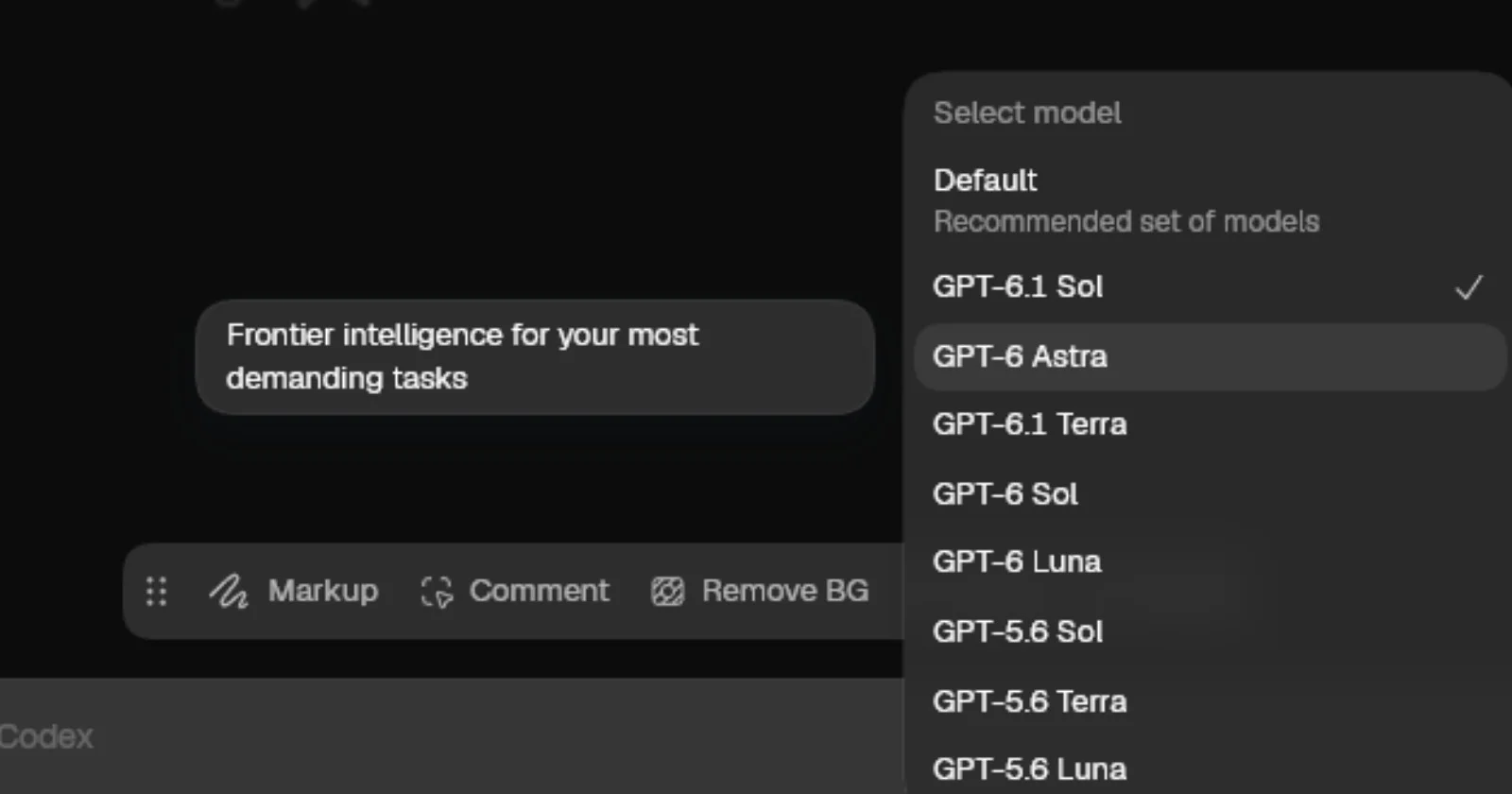
CNBC reported that companies in Daybreak, OpenAI's application-based cybersecurity program, got access first. OpenAI said Astra would then reach ChatGPT Plus, Pro, Business, and Enterprise users, the OpenAI API, Microsoft Azure, and AWS Bedrock. The free and Go plans weren't on that list. And in the ChatGPT app, Astra isn't what most people get by default. OpenAI's October 7 release notes say Plus, Pro, Business, and Enterprise chats default to GPT-6 Sol, Free and Go use GPT-6 Luna, and Pro's reasoning option uses Astra. OpenAI's developer guide lists GPT-6.1 Sol for near-Astra results at a lower cost, GPT-6.1 Terra for speed, visual reasoning, and writing, and GPT-6 Luna as the fastest and cheapest. Astra replaced GPT-5.6 Sol as OpenAI's flagship, and the gap between them is the clearest answer to the "GPT-5.6 vs GPT-6" question. On OSWorld 2.0, a test where the model has to finish real tasks on a computer, OpenAI says Astra scored 72.6% at roughly 40 minutes per task, while GPT-5.6 Sol scored 65.7% at roughly 75 minutes.
OpenAI's announcement is full of near-perfect scores: 98% on FrontierMath Tier 4, 99.9% on ARC-AGI-3, and 100% on ExploitBench, a test of turning known software flaws into working attacks, where GPT-5.6 Sol scored 78.5%. These are OpenAI's numbers on tests OpenAI picked to report, so treat them as the company's case for the model and wait for independent testing before treating them as settled. Crowd voting tells a different story for plain chat. On Arena's text leaderboard snapshot from October 27, GPT-6 Astra ranked 37th, while Claude Opus 5.5 was third and Claude Fable 5.1 fifth. Arena ranks the chat answers people prefer, so it says little about computer use, which is Astra's main pitch.
OpenAI says Astra "meets the Critical threshold in cybersecurity under our Preparedness Framework," the top level in its own risk system, and CNBC reported it's the first OpenAI model to get there. The public version helps with defensive work like secure code review and patching, but OpenAI says it refuses more advanced tasks, like building proof-of-concept exploits. Its extra safety checks can also pause a task in ChatGPT or Codex and ask you to review the action, while in the API the task simply stops. OpenAI admits these checks sometimes interrupt legitimate work. Sam Altman told CNBC Astra was a "new capability level" that had changed how he works. Anthropic has held back a model of its own, too. Its pricing page lists Claude Mythos 5.1 as limited availability, and its IPO filing says it limited Mythos's early availability through Project Glasswing.
How Astra compares with Claude on price
OpenAI's model page prices Astra at $10 per million input tokens and $50 per million output tokens, with cached input at $1. A token is a chunk of text a few characters long. Prompts over 272,000 input tokens cost twice as much for input and one and a half times as much for output. The context window, the amount it can read at once, is 1,050,000 tokens, it can write up to 128,000 tokens in one reply, and its knowledge stops at April 30, 2026.
That's exactly what Anthropic charges for Claude Fable 5.1: $10 in and $50 out. Claude Opus 5.5 costs $4 in and $20 out, so Astra is 2.5 times the price of Opus per token. OpenAI argues the per-token price overstates the cost, since in several of its evaluations Astra used substantially fewer output tokens and its estimated cost per task came in lower than earlier models. That's plausible, but it's worth checking on your own workload before you take it on faith.
For a Claude user, Astra's real rival is Fable, the model you reach for when the job is hard enough to justify the bill. For everyday coding most people will weigh Astra against Opus 5.5, which costs less than half as much. Our guide to picking a Claude model covers when Fable is worth it, and if you can afford two subscriptions, using Codex to review Claude Code's work is still one of the better ways to get value out of both companies at once.
Sources
OpenAI: Introducing GPT-6 Astra - September 3, 2026. The announcement, rollout plans, computer-use examples, benchmark scores, OSWorld 2.0 comparison with GPT-5.6 Sol, the Critical cybersecurity threshold, refusals, and safety-check pauses.
OpenAI developer docs: Using GPT-6 - The GPT-6 family lineup of Astra, GPT-6.1 Sol, GPT-6.1 Terra, and GPT-6 Luna, and the claim of lower cost per task.
OpenAI developer docs: GPT-6 Astra model page - API pricing, long-prompt pricing, context window, maximum output, and knowledge cutoff.
CNBC: OpenAI begins rolling out Astra model after warning of its advanced cyber capabilities - September 3, 2026. Daybreak program access, the first model to reach the Critical threshold, and Sam Altman's comments.
Anthropic: Claude API pricing - Claude Fable 5.1, Claude Opus 5.5, and Claude Mythos 5.1 prices and limited availability.
SEC: Anthropic, PBC Form S-1/A - Filed November 2, 2026. Limiting Mythos's early availability through Project Glasswing.
OpenAI Help Center: ChatGPT release notes - October 7, 2026. Default ChatGPT models by plan and Astra in Pro's reasoning option.
Arena text leaderboard - October 27, 2026 snapshot with GPT-6 Astra at 37th and Claude Opus 5.5 and Fable 5.1 in the top five.