Anthropic published an explanation of how the text watermark in Claude actually works, two weeks after switching it on.
Meanwhile subscribers are cancelling. Business Insider reported dozens of users dropping their plans over it, with enterprise and individual customers ending Max subscriptions over authorship and compliance worries, and Forbes noting there is no way to opt out. On Reddit somebody called it a conspiracy against innocent Claude users.
The watermark rides on choices Claude was already making
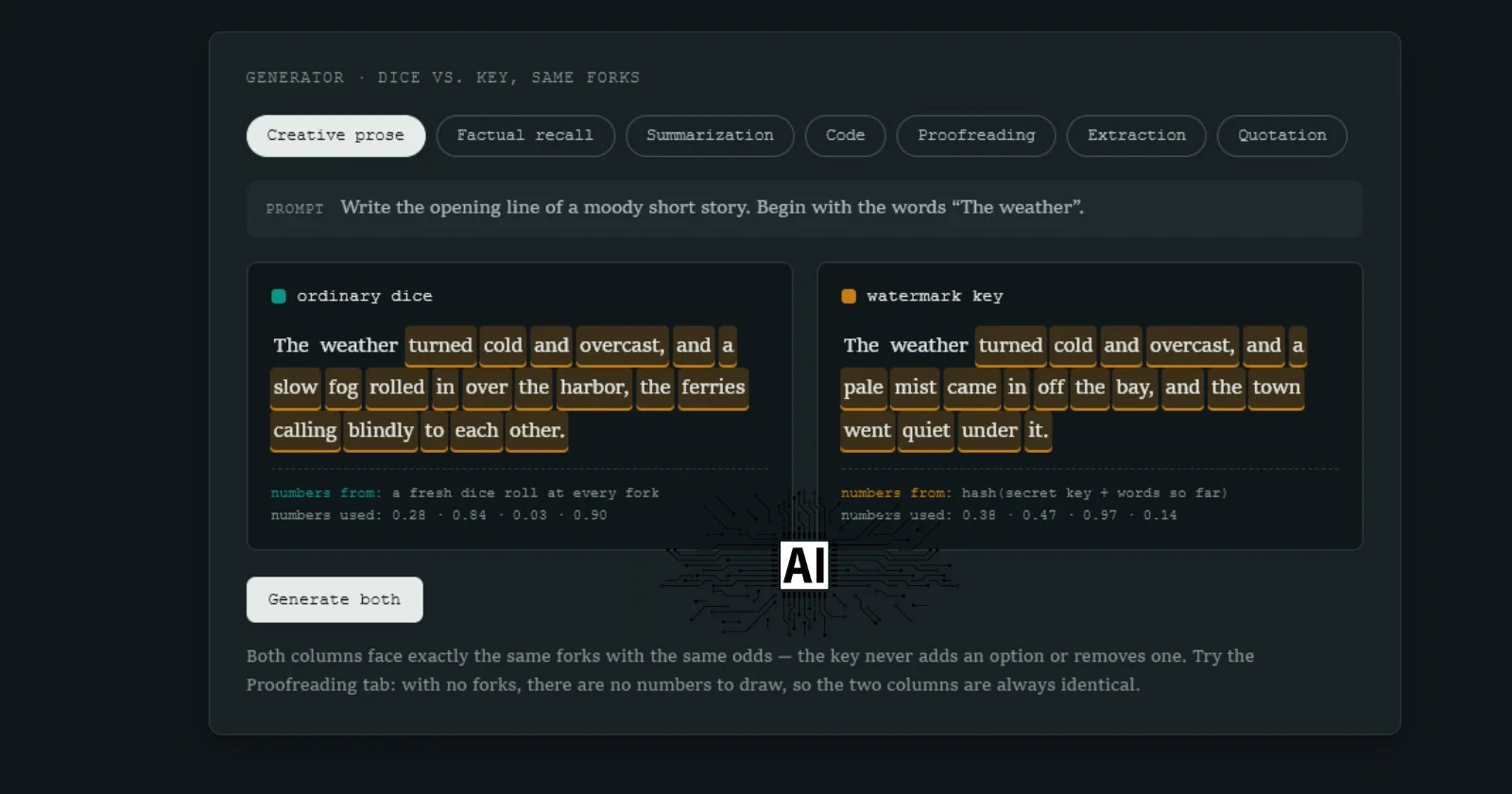
Start with a fact about how these models write that most people never think about. Ask Claude the same question twice and you get two different answers, because it picks one word at a time and at many of those points several words are equally good. A random number breaks the tie. Then that choice becomes part of the context for everything after it, so an early fork sends the whole answer down a different road.
So what does the watermark do? The watermark does one thing. It changes where that random number comes from. In Anthropic's words, "instead of using an arbitrary random number generator to pick the next word, watermarking uses the key and a few words that come before to settle what word the model should pick."
The same list of candidate words at every fork, same odds, only the coin flip is different. Later, anyone holding the key can re-derive which choices it would have produced and check whether the text matches. As Anthropic puts it, you "check the sequence of words and see if it's consistent with the choices Claude would make if it was using the key" and from that “assign a probability that the text was generated by Claude.”
The quality complaint
The loudest objection I saw was that watermarking must degrade the writing, that Claude is being forced into worse word choices to carry a signal. The company says that isn't the case and addresses it directly: the watermark "wouldn't make Claude pick a word like 'nubilous'", an obscure synonym for overcast that Claude wouldn't reach for anyway.
The watermark only ever picks among options that were already on the shortlist with the odds they already had. It never adds a candidate and never removes one. Anthropic says testing found "no statistically significant differences from the unwatermarked model" in user ratings, and that “to a reader, a watermarked response is indistinguishable from an unwatermarked one.”
But nobody really wants this
But all of that misses the more basic objection: nobody wants their writing to be watermarked or detectable in the first place. Whether the watermark changes quality is almost beside the point. People use Claude to draft emails, edit articles, brainstorm, write code documentation, polish reports, and do work they may substantially rewrite afterward. They do not necessarily want that text carrying an invisible statistical signature that can later be used to argue it came from Claude. You can explain that the signal is subtle, probabilistic, and harmless to the prose, but for a lot of users the problem is simply that the signal exists at all, especially when there is no way to turn it off. That's why there's backlash and many people are threatening to cancel their subscriptions.
Why Anthropic did it
The complaint that survives is consent because there is no opt-out. Article 50 of the EU AI Act became applicable on August 2 and requires machine-readable marking, so that's a real reason why they probably did it, but Anthropic applied it worldwide rather than only where the law reaches. A paying customer in Ohio now ships a mark they didn't agree to because of a Brussels regulation, and when you're billing someone two hundred dollars a month, "you cannot turn this off" is going to make people angry.
Someone who can figure out how to remove the watermark while having the text read in certain voices and not “AI-slop like" can make a ton of money. Which is precisely the business I argued somebody will get rich building.
Sources
Anthropic: How Claude's text watermark works - The August 14, 2026 explanation covering key-derived sampling replacing the random number generator at high-entropy word choices, detection as an assigned probability, the finding of no statistically significant quality difference from the unwatermarked model, the nubilous example, sparser watermarking on factual passages and code, the limits on grammar-only edits and proofreading, the effect of passage length, the inability to identify users or distinguish other AI models, and the note that a complete rewrite removes the mark.
Forbes: Claude users can't opt out of new watermarks - The absence of an opt-out and the scale of the online reaction.
Inc: Anthropic's new AI watermark sparks backlash from Claude subscribers - Coverage of the subscriber backlash, including reporting that dozens of users cancelled and that enterprise and individual customers ended Max subscriptions over authorship and compliance concerns.