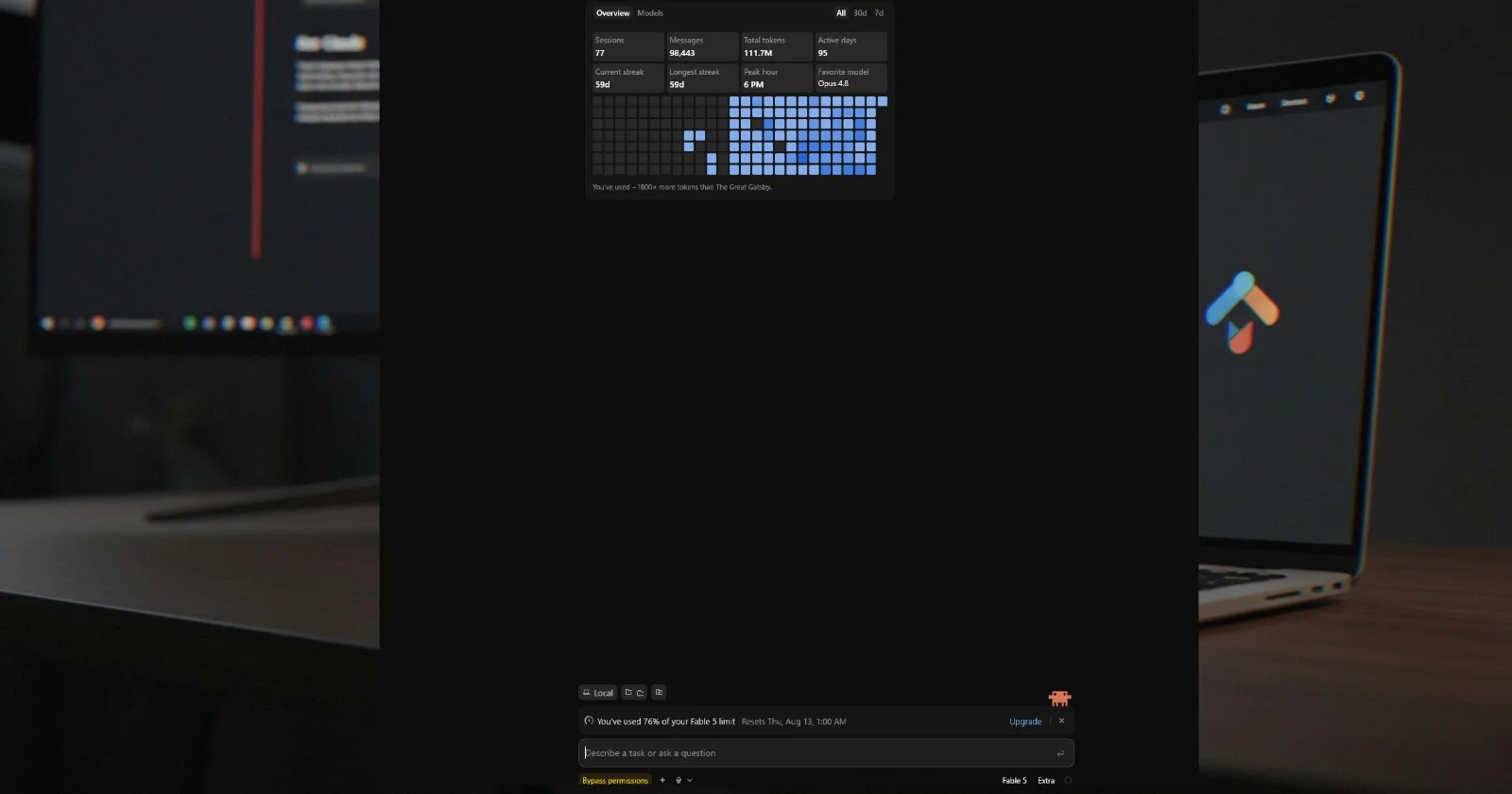

Claude Opus 5 sits near the top of the independent intelligence rankings. Anthropic calls it a step-change over Opus 4.8, with the biggest gains in deep reasoning and long-horizon agentic work. Sonnet 5 posted large gains over Sonnet 4.6 on coding. By the numbers this is the strongest Claude lineup there has been, but a lot of longtime users say it got worse to work with. The complaints repeat across Reddit and the Claude Code issue tracker: it's verbose/too wordy, too confident, hard to steer, and always determined to turn a two-line request into a project.
Claude has been optimized to act, not merely answer
The central change is that Anthropic is increasingly building Claude as an autonomous agent rather than a conversational assistant.
Sonnet 5 was introduced as the company’s “most agentic Sonnet model yet.” It plans, searches, uses terminals, checks its own output and persists through multi-step tasks. Opus 5 extends the same philosophy to longer and more demanding work.
Those behaviors are valuable when Claude is asked to investigate a complex bug or refactor a large codebase. But they can become irritating when the user wants a narrow answer or just a small edit. A model trained to anticipate the next five steps may resist doing only step one. It may inspect unrelated files, suggest architectural changes, explain its plan, verify its result and summarize the verification. From the model’s perspective, this is diligence. From the user’s perspective, it is scope creep.
One complaint filed in the Claude Code repository describes answers padded with caveats, forced metaphors and invented business jargon. Other users report that Claude increasingly “pushes back” on their instructions or behaves as though it should lead the conversation.
These are anecdotes, not controlled evaluations. But they point toward a consist
The verbosity is real
The simplest explanation for why Opus 5 feels more verbose is that it is more wordy.
Anthropic’s own migration documentation says Opus 5’s default responses and written deliverables “run longer” than those of Opus 4.8. It also says the model narrates its progress more often, delegates more readily and verifies its work without being instructed to do so. Anthropic specifically warns developers to remove old verification prompts because they can cause the new model to over-verify.
That matters because verbosity is not just an aesthetic problem. Long answers:
- take more time to read
- make the actual decision or result harder to find
- consume more output tokens
- exhaust subscription limits faster
- introduce more opportunities for qualifications, contradictions and tangents
Some users also object to the character of the prose, not merely its length. The complaint is that Claude now compresses ideas into elaborate phrases, managerial language and dramatic contrasts. Asking it to “be concise” can produce denser writing rather than clearer writing. In other words, the model may reduce the number of words without reducing the cognitive burden.
More thinking can turn into overthinking
Both Sonnet 5 and Opus 5 use adaptive thinking by default. Anthropic also gives users an effort control that determines how much computation and how many tokens the model can spend.
The natural assumption is that increasing effort should produce a strictly better answer. In practice, additional reasoning can sometimes cause a model to explore unnecessary alternatives, reconsider valid decisions or repeatedly verify work it has already completed.
Anthropic’s guidance says lower effort levels can retain strong performance at a fraction of the cost and latency. External testers cited in Inc.’s coverage reported self-correction loops and cases in which Opus 5 performed worse at higher effort on evaluations that penalized unnecessary work.
This helps explain the distinctive “smart-dumb” failures users describe. Claude may identify the difficult part of a problem correctly, then continue thinking until it talks itself out of the answer. Or it may expand a straightforward fix into a broader redesign, creating new problems through sheer activity.
That is not necessarily lower intelligence. It is poorly calibrated intelligence.
The tokenizer quietly shrank your budget
Here is what explains the feeling that your allowance is evaporating.
Sonnet 5 ships a new tokenizer. Per Anthropic, "the same input text produces approximately 30% more tokens than on Claude Sonnet 4.6." Per-token pricing came down, from $3 and $15 to $2 and $10, and the docs are upfront that this does not net out the way it looks: "the cost of an equivalent request does not drop in direct proportion."
The context window is 1M tokens, but each token covers less text now, so the same window holds less of your project than it did. An output limit tuned for 4.6 can truncate the same answer on 5.
Stack that against responses that run longer by design and a model that thinks by default, and the arithmetic turns unfriendly. More tokens per word, more words per answer, more thinking per request, against limits that never moved. People describing this as burning through their plan faster are describing something real, and it is three separate changes compounding rather than a degraded model. We went through the effort dial as the main lever on it separately.
Benchmarks do not measure the cost of being annoying
The strongest argument against the “Claude is getting dumber” narrative is that the new models perform extremely well on demanding evaluations. Opus 5 has led independent intelligence and coding-agent rankings, while Anthropic reports large gains for Sonnet 5 over Sonnet 4.6 on agentic coding.
Some reviewers have reached an awkward verdict: Opus 5 is frustrating to collaborate with but still produces the best final work. One blind evaluation described in Inc. ranked it above competing models despite the tester disliking its personality and verbosity.
This reveals a blind spot in AI evaluation. Benchmarks typically score whether a task was completed correctly. They rarely measure how many unnecessary paragraphs the user had to read, how often the model challenged reasonable instructions or how much effort it took to keep the model within scope.
But those qualities determine whether people want to use a system every day.
Claude may not be getting worse. It may be getting worse at being Claude
Older versions of Claude developed a reputation for calm prose, nuanced conversation and an ability to understand what the user meant without turning every exchange into irritation. For many customers, that character was part of the product, not decorative personality layered over raw intelligence. That's why many people say Opus 4.6 back in February 2026 felt the best and it's been only going downhill since.
Sonnet 5 and Opus 5 represent a different set of priorities: autonomy, persistence, verification and long-horizon execution. Those changes make Claude more useful as a background worker. They can simultaneously make it less satisfying as a writing partner, tutor or interactive coding companion.
That is why the disagreement is unlikely to be resolved by another benchmark chart. Both sides may be accurately describing the same model.
Claude 5 can be more capable and still feel worse. It can complete harder assignments while imposing greater attention costs. It can make fewer substantive errors while becoming more exhausting to supervise. It can be a better agent and a worse conversational colleague.
The criticism, then, is not simply nostalgia or resistance to change. It is feedback about what the industry has chosen to optimize. AI companies are teaching models to do more on our behalf. The next challenge is teaching them to know when enough is enough.
Sources
Anthropic: What's new in Claude Opus 5 - The behavior changes stating that responses and written deliverables run longer, the model narrates progress more often, delegates to subagents more readily and verifies its own work without being told, the instruction to remove carried-over verification prompts because they cause over-verification, thinking on by default as a change from Opus 4.8, the effort ladder with the note that low and medium hold quality at a fraction of the tokens, and the 1M token context window.
Anthropic: What's new in Claude Sonnet 5 - The new tokenizer producing approximately 30% more tokens for the same input text than Sonnet 4.6, the $2 and $10 pricing against Sonnet 4.6's $3 and $15 with the note that equivalent request cost does not drop in proportion, the effect on context capacity and max_tokens budgets, and adaptive thinking on by default.