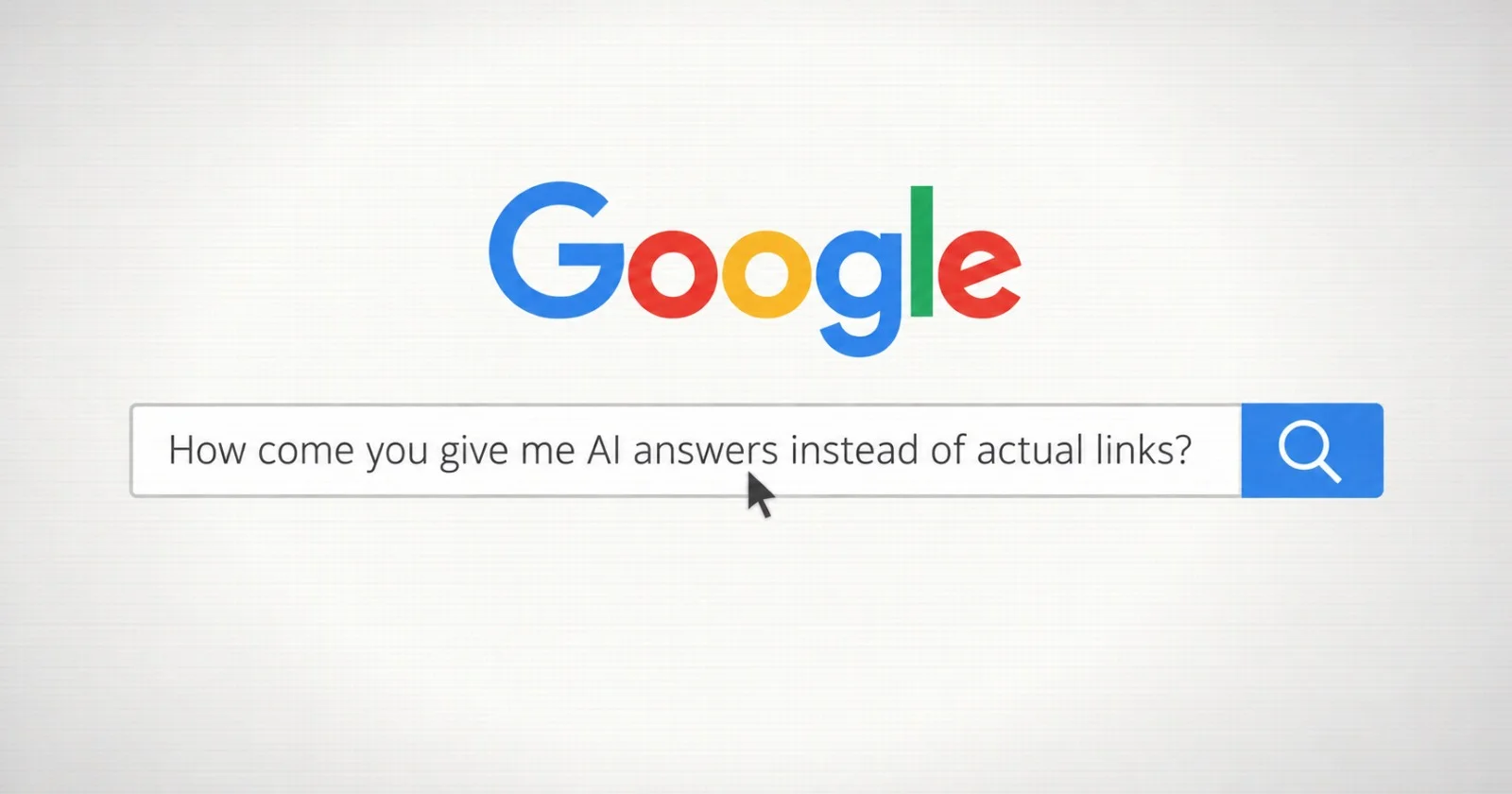

If you're still pouring all your energy into ranking on Google and ignoring AI search, you're optimizing for the past. People are getting lazy, I can attest to this after using Claude Code and LLMs. People always get lazy when something easier shows up, and instead of “googling” something and clicking through three blue links and “actually reading” to piece together an answer, they're just asking ChatGPT and going "give me the answer." And the AI does the hard part and hands it to them. No clicking, no scrolling, no visiting your beautifully SEO'd Rich Data page. That changes everything about how you get found, and the data backing this up is honestly kind of staggering.
ChatGPT is now bigger than Google?
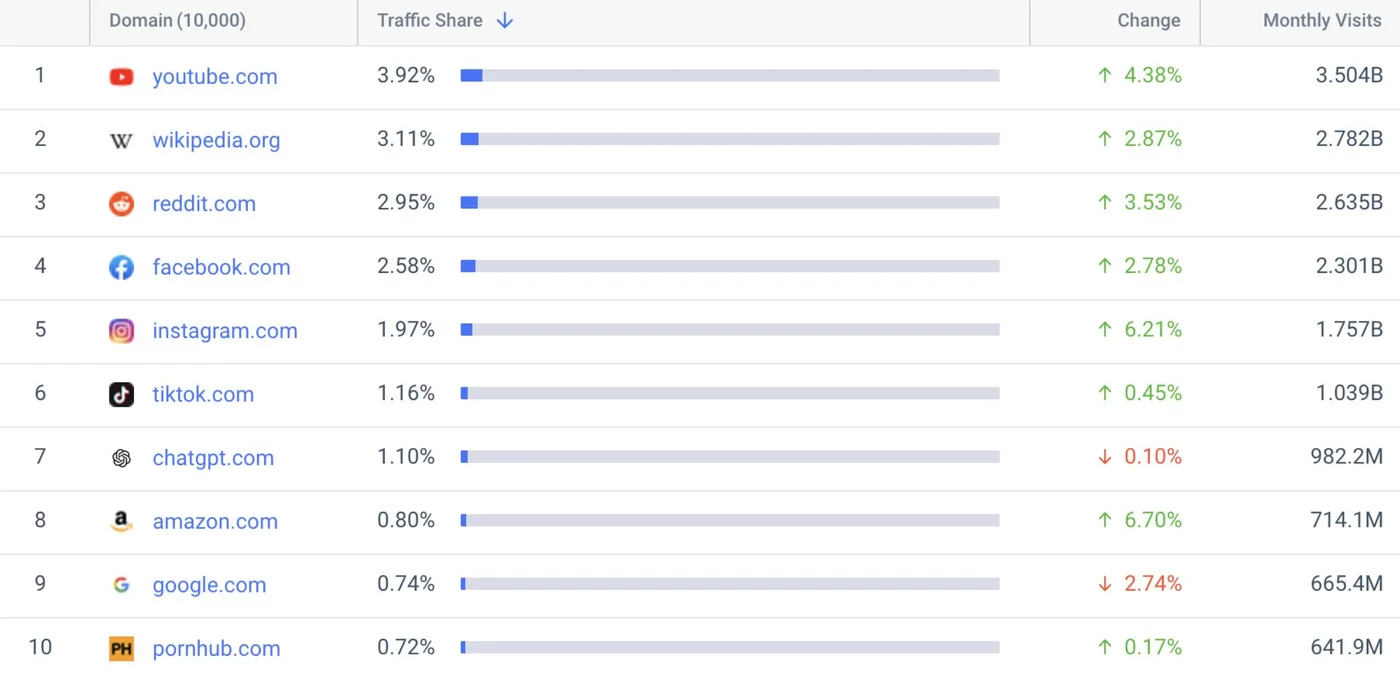
I was scrolling on Twitter and saw that SimilarWeb put out the top 10 websites in the world for search traffic for May 2026, and ChatGPT.com landed at number 7 with 982 million monthly visits, while Google.com sat at number 9 with 665 million visits for search traffic. ChatGPT is pulling more search traffic than Google's own domain now according to SimilarWeb. And look at the direction each is moving: ChatGPT basically holding steady while Google.com was down 2.74%. The little search box that ate the world is getting eaten itself, and the thing eating it is the chatbot.
Now, a caveat is that's google.com the main domain, not all of Google search across every entry point, so it's not a perfect apples to apples and Google's overall reach is still gigantic. But the trend line is the story. ChatGPT went from not existing to outranking Google's main domain in SimilarWeb's search traffic metric in about three years, and it's still climbing while Google slips. You don't need it to be a perfect comparison to see where this is all heading.
And the referral data underneath it is even more telling for people like us who live on traffic. AI-referred sessions jumped 527% year over year in the first five months of 2025. AI traffic grew nearly 10x in the past year, and visitors referred from AI convert at rates up to 23 times higher than traditional organic search, because someone the AI sent to you was basically handed your name as a recommendation, so they show up already warm. This isn't a rounding error anymore. It's the fastest-growing discovery channel on the internet.
A real example, because I like receipts
My buddy Paul who runs claudefolio.com also runs a site called scratchcheck.com, lottery scratch-off data, exactly the kind of factual lookup people used to google. He's been watching his “Google Analytics,” and his site is now pulling roughly twice as much traffic from chatgpt.com as it gets from Google. Two times. From the chatbot. On a site that lives and dies on people looking up factual info.
That's the whole shift from one real data point. The queries that used to start on Google, "what's the top prize left on this scratch ticket," "which scratchers have the best odds," now a big chunk of those start in ChatGPT instead, and when the AI cites his site or sends the user over, that's traffic Google never touched. His ChatGPT-User and Claude-User referrals keep climbing month over month while his Google clicks keep sliding. He didn't do anything magic. He just happened to have the kind of clean, factual, well-structured content the AI likes to pull from, and he's reaping it while sites that optimized purely for Google keywords are watching their clicks evaporate into AI Overviews. Paul also says his DuckDuckGo, Yahoo, and Bing clicks are climbing as well. Perhaps more people are switching off from Google Search as well?
Why the old Google playbook is losing steam
The core problem with optimizing only for Google SEO now is that Google increasingly doesn't send you the click even when you win the ranking. You rank number one, Google's AI Overview scrapes your answer, shows it at the top, and the user never scrolls down to see your ranking spot. You did the work, the AI ate the reward. So even your Google "wins" are quietly turning into zero-click losses.
Meanwhile the AI engines are playing a different game entirely, and the overlap between winning on Google and getting cited by AI is shrinking fast. Research found the overlap between top Google links and AI-cited sources dropped from around 70% down to below 20%, and that gap keeps growing as AI systems develop their own preferences for which sources to cite. Read that again. Ranking on page one of Google no longer guarantees you show up in the AI answer, and showing up in the AI answer doesn't require ranking on page one. They've become two separate games. If you only play the Google one, you're invisible in the place people are increasingly going first.
And the AI answer is a brutally short list. AI engines typically name only 2 to 4 brands per buying query, versus the 10 blue links on a Google results page, which makes being in that answer set way more valuable and way more winner-take-all. Google gave you ten slots to fight for. ChatGPT gives you maybe three. Miss the cut and you don't exist for that query.
So how do you actually optimize for AI search
Good news, you don't throw out everything you know, because a lot of SEO fundamentals still feed into this. But there are specific moves that matter for getting cited by ChatGPT, Claude, Perplexity, and the rest. This whole discipline has a name now, people call it GEO, generative engine optimization, or AEO, answer engine optimization, same idea either way.
Answer the question first, immediately, at the top. AI systems that pull from the web judge a page mostly on its opening content, so the first 200 words should directly and completely answer the query instead of building up to it. No long winding intro. State the answer, then elaborate. The AI is skimming for the extractable answer, so hand it over up front.
Write for the fan-out. When someone asks an AI a complex question, it doesn't search the whole thing, it breaks it into smaller sub-queries and searches each one separately. So a question like "best scratch-off in Texas under five bucks" might get split into "Texas scratch-off odds," "cheap scratch tickets," "best Texas lottery games," and your content needs to cover those sub-pieces, not just the one headline phrase. Think in clusters of related questions, not single keywords.
Load up on hard facts, dated and specific. Specific, dated, sourced numbers get cited, so fact density matters, along with answer-first structure, schema markup, and earning citations from trusted third-party lists the AI reads. Vague fluff doesn't get pulled. A concrete number with a date does. This is also why factual data sites are cleaning up right now, they're nothing but the citable stuff.
And the one people forget that's pure self-sabotage if you skip it: let the AI crawlers crawl your site. Open crawler access for OAI-SearchBot and other LLM crawl agents in your robots.txt, because if you blocked them back when everybody panicked about AI scraping, you've locked yourself out of the exact engines you now want citing you. Go check your robots.txt right now. A lot of sites quietly disallowed these bots in 2024 and forgot, and they're wondering why they never show up in AI answers. I understand these bots can take up a lot of server resources as well that may hurt your site's performance so that's also a question you have to ponder when opening up to AI crawlers.
But don't be dumb about it, this is "also," not "instead"
Don't be dumb and literally abandon Google. Anybody telling you to torch your SEO and go all-in on AI is selling you something you don't want to buy. GEO isn't a replacement for SEO, it's an additional layer, and the brands winning at AI citation are usually the same ones with strong traditional SEO foundations, because the AI retrieves from the web and good SEO feeds the AI. Google itself said its AI features run on the same core ranking systems as regular search. So the smart framing isn't "stop optimizing for Google," it's "stop optimizing ONLY for Google," because the stuff that makes you citable to AI mostly makes you stronger on search too. You're not switching teams. You're adding a second field to play on and that second field is growing while the original field shrinks.
What's actually changing is where you point your attention at the margin. The hours you used to spend chasing the exact keyword phrasing and stuffing it in your H2s and building topical authority on the keywords, redirect some of that toward answer-first structure, fact density, and making sure the good AI crawlers can read you. Same content engine, tuned for a world where the answer increasingly gets delivered by a chatbot instead of a list of links.
The window is closing faster than you think
Here's why I'm telling you this now instead of in a year. There's a first-mover or early adopter reward happening. The citation preferences AI models build now are sticky, so brands that build their AI visibility early accumulate a citation bias that competitors starting later have to fight uphill against. The AI learns who the trusted sources are, and once it's decided you're one of them for a topic, that's hard for a latecomer to dislodge. Being early to AI search is like being early to Google SEO in the 2000s, the people who got in then spent the next decade ranking for free and earned good ad money.
So the move isn't to panic and abandon what works. It's to wake up to the fact that the front door of the internet is quietly moving from a search box to a chat box, and the people optimizing for the chat box right now are claiming territory the latecomers will have to pay dearly for. People are getting lazier, the AI is getting better at just handing them the answer, and that trend only goes one direction. Optimize for where the eyeballs are heading, not just where they used to be. Paul's site is already getting double the traffic from ChatGPT versus Google. That's not the future. That's right now, and the gap is only widening.
Sources
Frase: What Is Generative Engine Optimization - The 527% year-over-year jump in AI-referred sessions, the query fan-out and retrieval mechanics, and Google's May 2026 guidance that AI Overviews run on the same core ranking systems as regular search.
Discovered Labs: What Is GEO - AI traffic growing nearly 10x in a year, AI-referred visitors converting up to 23 times higher than organic search, and the prediction that traditional search volume drops as AI answer engines take over.
LLMrefs: Generative Engine Optimization 2026 Guide - The query fan-out mechanic, and the finding that overlap between top Google links and AI-cited sources dropped from around 70% to below 20%.
Siftly: Generative Engine Optimization 2026 Guide - The point that AI engines name only 2 to 4 brands per query, plus the core GEO tactics: answer-first content, schema, fact density, third-party citations, and open crawler access for GPTBot, PerplexityBot, ClaudeBot, and Google-Extended.
Enrich Labs: The Complete 2026 Guide to GEO - The first-200-words answer-first rule, and the argument that GEO is an additive layer on top of SEO rather than a replacement.
BrandClickX: GEO 2026 Guide - The first-mover citation-moat dynamic where early AI visibility compounds into a lasting advantage competitors struggle to overcome.