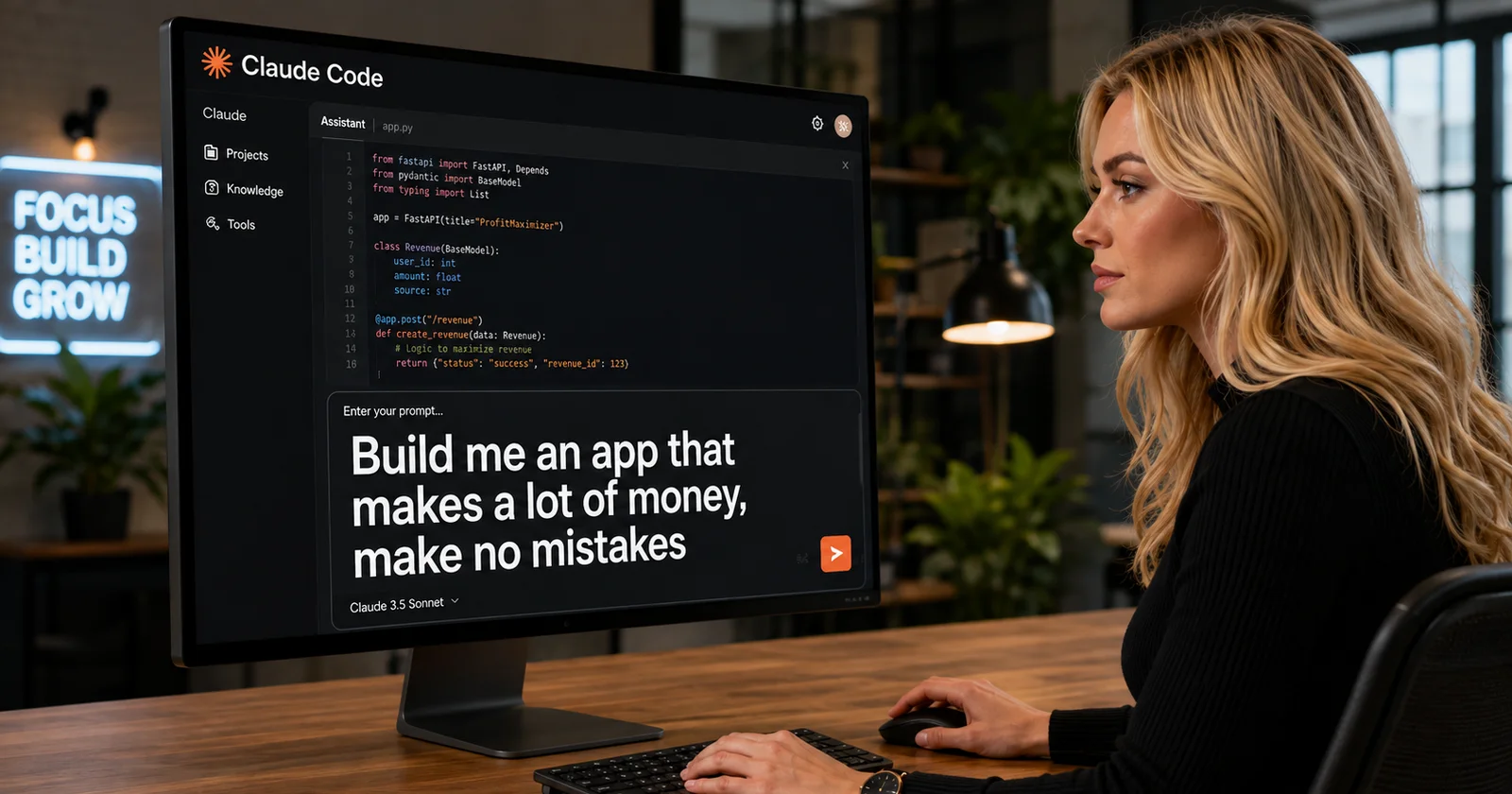
Okay somebody needs to say this out loud because everybody building their little SaaS with Claude Code right now is having a great time and not thinking about the obvious problem sitting right in front of them… The same tool you used to build your SaaS in a weekend? Your customers have access to it too. And the second they figure out that the thing they're paying you for is something they could just build themselves in an afternoon, a chunk of them are gonna do exactly that. I'm not trying to ruin your day. I'm trying to save you from finding this out the hard way.
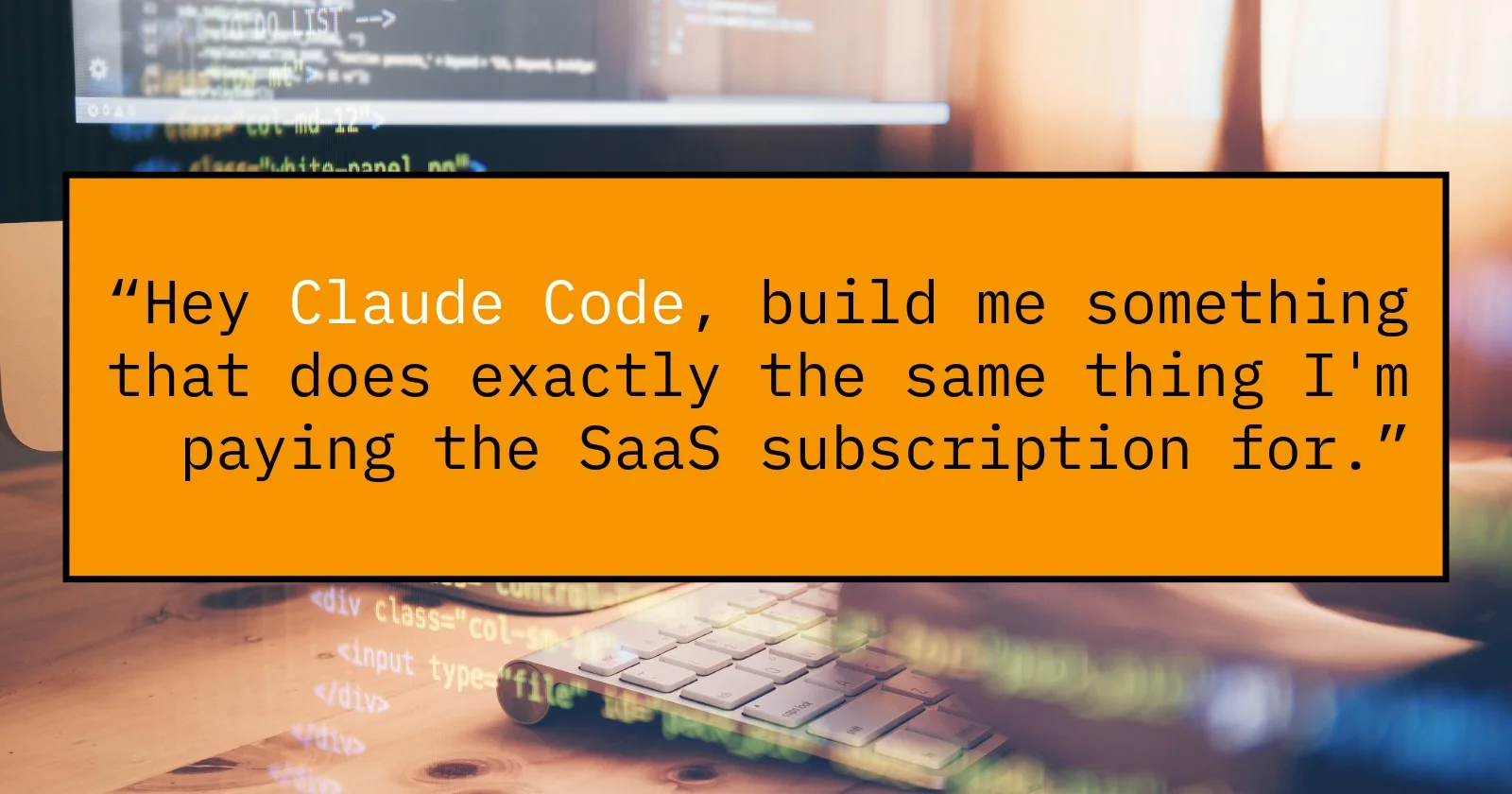
“Hey Claude Code, build me something that does exactly the same thing I'm paying the SaaS subscription for.”
What nobody wants to admit
A ton of the micro-SaaS getting cranked out right now is thin. Like, anorexic thin. It's a nice wrapper around a model, a clean interface on top of something the underlying AI already does, a workflow somebody bundled up and slapped a subscription on. And yeah, that's been a legit business for a long time, charging people for convenience, packaging up something annoying into something easy. No shame in the hustle.
But here's what changed. The reason wrapper businesses worked is that building the wrapper took skill the customer didn't have. You knew how to code, they didn't, so they paid you to do the part they couldn't. That was the whole arrangement. The gap between "I want this" and "I can build this" was your business model. And Claude Code just closed that gap for a huge number of people. The customer who couldn't build it last year can describe what they want to an AI this year and get something workable out the other end. The skill you were selling is getting handed out for twenty bucks a month to everybody, including the people currently paying you.
So if your SaaS is basically "I did a thing with AI that you could now also do with AI," you don't have a business, you have a head start. And what happens when that head starts run out?

The numbers are already ugly
This isn't me being just dramatic for clicks. The market's already pricing this in. In February 2026 a single week of news wiped something like two trillion dollars in market value off SaaS stocks. Two trillion, with a capital T. Gartner is predicting that 35 percent of point-product SaaS tools get replaced by AI agents by 2030. And the wrapper carnage is brutal already, with something like 90 percent of AI wrappers reportedly failing, running on margins of like 25 to 35 percent before they die.
Want specific bodies? Chegg got gutted, collapsing from a 14 billion dollar company to under 200 million after ChatGPT made its whole core service pointless. Stack Overflow watched its questions drop 76 percent and traffic fall by half. Even Jasper, which was the golden child of AI-native SaaS, had to slash its forecasts and cut its own valuation. These weren't dinky little projects. These were real companies that got steamrolled when what they sold became something people could just get somewhere else, cheaper or free.
Now here's the part that should actually scare the Claude Code crowd specifically. It's not just customers building their own stuff. It's also the model companies themselves. When Anthropic shipped a tool that scans code for security holes, a bunch of cybersecurity stocks cratered the same day, CrowdStrike, Cloudflare, the whole sector took a hit. The companies making the AI can absorb your entire product into a feature whenever they feel like it. You're not just competing with your customers now, you're competing with the people who make the tool you built on. That's a rough spot to be standing in.
The gold rush mentality is the trap
Right now there's this gold rush energy where everybody's shipping SaaS as fast as they can because the building got so easy, and the easy building feels like you have to take advantage of an opportunity… But it's not. The easy building is the problem. When something becomes easy to build, it becomes easy to build for everybody, not just you, which means it stops being valuable to have built it. The thing you're celebrating, "look how fast I shipped this," is the exact thing that means anybody else can ship it just as fast, including the person you were hoping would pay you for it.
The gold rush guys in 1849 mostly went broke, by the way. The people who made money were the ones that were selling shovels, and the few early ones who found a real claim and actually held it. Everybody else just dug a lot of holes and went home. A whole lot of weekend SaaS right now is digging holes in ground everybody else can dig too, and calling it a business because it made forty bucks last month.
So am I telling you to quit?
Nah. I'm telling you to be honest about what you've actually got. If your SaaS would survive your customer realizing they could rebuild it themselves, great, you've got something real and you can stop reading. But if your gut just did a little flip when you read that, if some quiet part of you knows the only reason people pay you is that they haven't figured out they don't have to yet, then you've got a clock running and you should know it's running.
The convenience-only play, where your whole pitch is "I'll do the easy thing so you don't have to," is on borrowed time when the easy thing gets easy for everyone. That doesn't mean you're dead tomorrow. People are lazy, people don't want to maintain their own tools, brand and trust and habit are real and they buy you time. But time is what it buys, not safety. The honest move is to use the head start you've got to build something underneath your SaaS that your customers can't trivially replicate, because the wrapper on top is no longer the thing keeping them around.
That's the doom version. The actual answer, what genuinely survives this and how you build it, is down below, and it's the more useful one. But I wasn't gonna give you the comfortable version without first making you sit in the uncomfortable one, because the founders who get wrecked by this are the ones who never let themselves feel the problem in the first place.
What could actually survive
So what keeps a customer paying you when they could just go build the thing themselves now? The people who've actually thought this through all land in the same place, the moats that last are the ones AI can't crank out overnight, and more to the point, the ones your customer can't crank out for themselves over a weekend either. The code was never the moat. Never was. The moat is all the stuff around the code, and most of it is stuff your customer flat out does not want to deal with even if they technically could.
Start with the most underrated one: nobody actually wants to maintain their own software. Your customer can absolutely have Claude Code spit out a version of your app this weekend. Then what? Now it's theirs. They own the bugs, the security holes, the thing breaking at 2am, the updates, the edge cases nobody saw coming, all of it, forever. That's not a product they built, that's a second job they gave themselves. A huge chunk of what people pay SaaS for was never "I can't build this," it was "I don't want to be responsible for this." Running the thing, maintaining it, answering for it when it breaks, that's a service, and your customer will happily keep paying you precisely so it stays your problem and not theirs. That's the same reason people who could absolutely run their own email server pay for a hosted inbox instead. Can isn't the same as want to.
Then there's the stuff your customer literally cannot reproduce no matter how good their prompt is, because it isn't made of code. Data is the big one. Your product piles up history and patterns and context the longer people use it, and that's what makes it actually good. A customer who rebuilds your app from scratch has a clone with amnesia. Same buttons, zero of the accumulated smarts that made your version worth using. They'd have to run it for two years to catch up to where you already are, and most of them aren't gonna do that to save a subscription fee.
Integrations are another one. Once your thing is wired deep into the other tools your customer's whole workflow already runs on, rebuilding all that plumbing themselves is a slog they do not want, even if Claude Code writes the connectors. And trust matters more than people give it credit for, especially anywhere money or compliance or real risk is involved. Your customer needs to believe the thing works and keeps working, and they're not gonna bet their own payroll or their own legal exposure on something they vibe-coded on a Saturday. They'll pay you to be the one holding that bag.
Notice that none of this is the software itself, which is exactly why "but the customer can build the software now" doesn't actually gut you the way it sounds like it should. The thing they can now build for free is the one part that was never really the point. What they're still paying for is everything around it, the not having to maintain it, the accumulated data, the integrations they don't want to redo, the trust they can't manufacture, the simple fact that it's your job to keep the lights on and not theirs. The tool handed your customer the ability to write the code. It did not hand them the desire to own and run a piece of software forever, and that gap is your whole business.
So what do you actually build next
The question before you build any SaaS now is not "can I build this," because yeah, you can, everybody can, that yes was awesome at first but is worth basically nothing anymore. The real question is "what am I gonna have six months in that some customer with the same tools couldn't just rebuild?" If the honest answer is nothing, you probably don't have a business, you've got a head start, and head starts run out, especially with more and more people using Claude Code. So either go find a real moat to bolt onto it or go build something else.
And here's the actually good news, because I don't want to leave you in a hole. The same shift that's wrecking shallow SaaS is genuinely great for anybody building the deep ones. Building the software costs almost nothing now, which means all the time you used to burn having Claude Code writing code, you can dump into the stuff that actually makes you hard to kill instead. Distribution. Piling up data. Wiring in the integrations, earning the trust, building the brand that the next guy with Claude Code can't shortcut his way past. The tool that made building cheap also handed you the hours to go build the moat. The founders who get that are in a stronger spot than founders have ever been, not a weaker one. They just have to actually spend the freed-up time on the right thing instead of cranking out wrapper number forty.
So, what happens when customers figure out they can build it themselves? Some of them will, sure. And the SaaS that was running purely on them not being able to is gonna have a rough time, and honestly it kind of deserves it, because it was never deep enough to justify itself in the first place. But the SaaS that was always about way more than the code, the distribution and the data and the trust and the grind of actually running the thing day in day out? Barely feels it. None of that was ever stuff a customer was gonna build for themselves anyway. So build that kind. Selling the act of building is over. Selling everything that wraps around it is just getting started. Remember this: The hard parts are still hard and people are genuinely lazy. Do the things they won't do and the things Claude Code can't do.
Sources
The roughly two trillion dollars in SaaS market value wiped out in a single week of February 2026 is documented in Advisable's analysis of micro-SaaS viability in 2026.
The Gartner projection that 35 percent of point-product SaaS tools get replaced by AI agents by 2030, the reported 90 percent failure rate for AI wrappers, and the Chegg and Stack Overflow collapses are cited in StartuPage's breakdown of AI-resistant micro-SaaS ideas for 2026.
The cybersecurity stock drops following Anthropic's security tooling launch, and the broader point about model companies absorbing products into features, are detailed in Hatchworks' piece on AI wrapper product strategy.
The framework of non-functional moats, SEO and brand and taste and data and trust as the advantages AI can't replicate overnight, is laid out in Steven Cen's piece on what actually defends a SaaS company in 2026, and the broader "the moat is not the model" argument is covered in this summary of Marc Andreessen's 2026 comments on AI moats.
These figures come from different sources using different methods and the situation is moving fast, so treat the numbers as directional and check current figures before relying on any specific one.