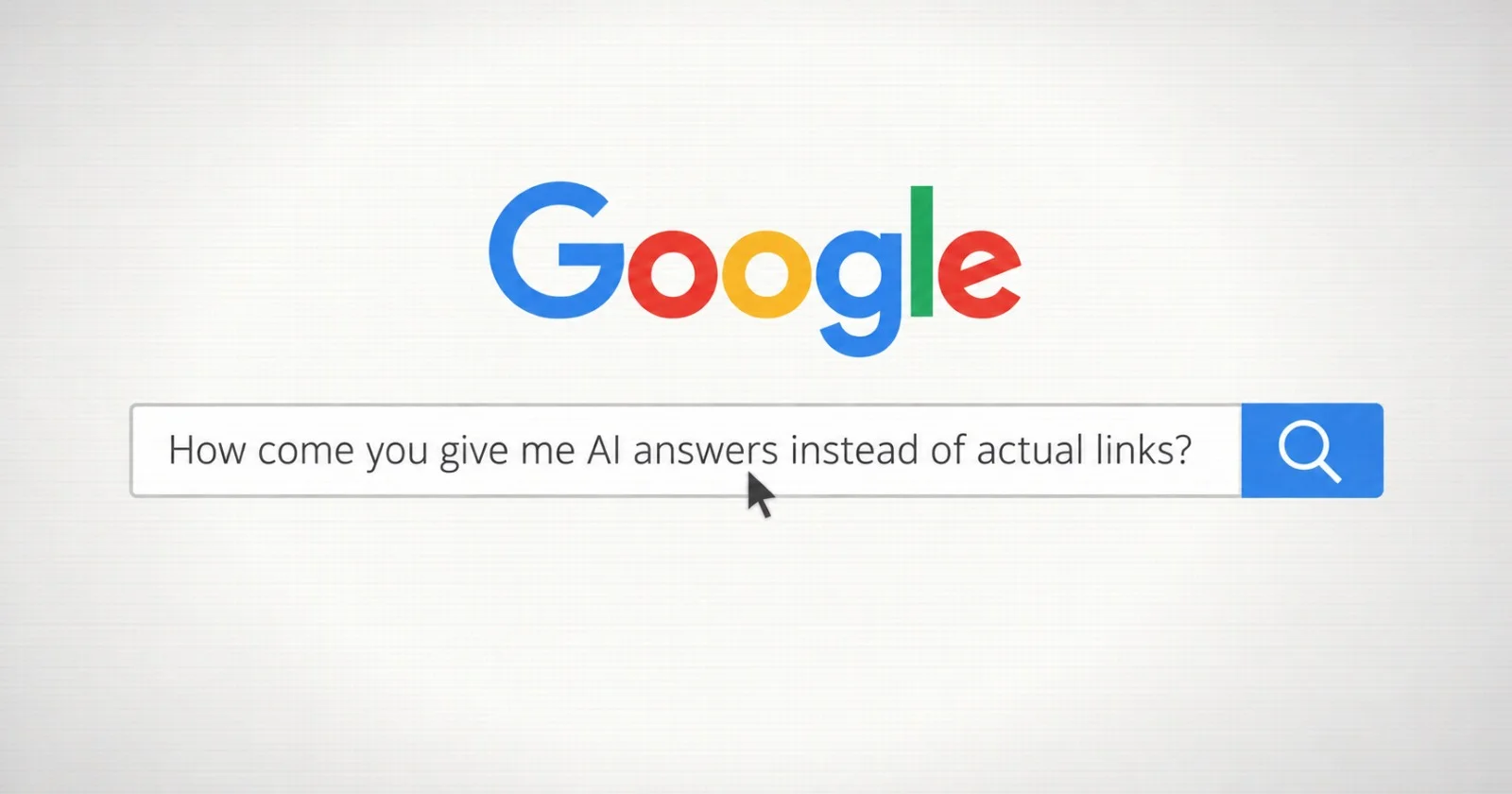

Be honest with yourself for a second. When's the last time you actually Googled something, scrolled past the ads, opened three tabs, skimmed two articles full of someone's life story before the recipe, and pieced together your own answer? Yeah. Me neither. Now you just ask Claude, ChatGPT, or your favorite LLM and it hands you the answer, done, no scrolling, no tabs, no reading. And here's the thing nobody wants to admit: the reason this shift is happening so fast isn't that the AI is some miracle. It's that we're lazy, and the AI lets us be lazier.
The shift is real and it's fast
This isn't me extrapolating from a feeling. The numbers are proving it out. A Fractl and Search Engine Land study found 66% of 18 to 24 year olds now use ChatGPT to find information nearly as often as Google. Two-thirds of young people. And it's not just the kids, 42% of people now prefer using AI chatbots over a search engine for multi-step research, and AI-driven search jumped from under 10% of interactions in 2023 to 30% by 2026.
Zoom out to the whole market and the ground really has moved. Google's share of combined information discovery fell from about 89% to below 58% in three years. Google didn't lose volume exactly, the total pie grew, but its slice of how people find things shrank hard, because a giant chunk of the new searching is happening in a chat box instead of a search bar. ChatGPT alone now represents roughly 20% of total global search-related traffic, making it the second-largest information discovery platform on earth. Three years ago it didn't exist as a search tool. Now it's number two. That doesn't happen because of marketing. It happens because it's easier, and easier always wins.

Why laziness is the engine
Let me make the case that this is fundamentally about friction, not magic. People don't switch tools because the new one is technically superior. They switch because the new one is less work. And Google quietly got to be a lot of work.
The receipts on the frustration are real. A Botify and YouGov study in January 2026 found 40% of people complain about clicking through too many links to find what they want. Forty percent. That's the friction the AI removes. Google turned into a gauntlet, an AI Overview at the top, then ads, then "people also ask," then more ads, then SEO-bait articles padded with 800 words of preamble before the one sentence you needed. Finding a straight answer became a chore. So when a tool shows up that just says the answer, no gauntlet, of course people take it. They're not lazy in some moral-failing way. They're doing what humans always do, which is take the path with less friction. The AI didn't beat Google by being smarter. It beat Google by being less annoying.
And this is exactly how every behavior shift works. Remote instead of getting up. Delivery instead of cooking. Streaming instead of the video store. The easier option shows up and the old effortful one becomes the thing only weirdos still do on purpose. "Give me the answer" beats "let me research and figure it out myself" for the same reason the elevator beat the stairs. We are, as a species, deeply allergic to unnecessary effort, and asking an AI is less effort. Game over. That trend only runs one direction.
The part that should give you pause
Here's the kicker. Only 6% of Americans say they have "a lot" of trust in AI search summaries. Read that against everything above. People mostly don't fully trust the AI answers, and they're using them anyway, in record numbers, because trust isn't what's driving the choice. Convenience is. We've reached the point where people will take an answer they're not even sure is right, over doing the work to get one they could verify, because the work is the part they want to avoid. That's a genuinely strange place to be.
And it gets worse when you look at how little people check. In Google's AI Mode, 88% of users took the AI's shortlist without any external verification, compared to 56% who built their own shortlist from multiple sources in classic search. So when the AI hands you a list of "best" whatever, nearly nine in ten people just accept it. No second source, no cross-check, no "let me see who else says this." Whatever the machine surfaced is the answer now. When you were forced to click around and read a few sources, you accidentally got exposed to disagreement, to other viewpoints, to the messy reality that there are usually several answers. The AI hands you one synthesized answer and strips all that away, and people are clearly fine trading the nuance for the speed.
That's the actual trade we're making, and it's bigger than search. We're outsourcing not just the finding but the judging. The skill of researching, comparing sources, smelling out which one's full of it, deciding for yourself, that's a muscle, and the AI is offering to do all of it for you. Use a muscle less and it weakens. A generation that mostly asks the machine and takes the answer is a generation that gets worse at the underlying skill of figuring things out, and most of them won't notice it happening, because the convenience feels like pure upside right up until you need to evaluate something the AI got wrong and realize you've forgotten how.
It's not all decline
Let me steelman the other side, because I'm not here to be the old man yelling at the chatbot. There's a real case that this is mostly good, and I half believe it.
For a ton of stuff, the old way genuinely was a waste of your life. Wading through ten links and three SEO-padded articles to learn one fact was never noble, it was just friction we'd accepted because there was no alternative. If the AI gives you that fact in two seconds and it's right, that's a pure win, you got your time back. There's also research showing AI tools are mostly expanding total search activity rather than purely cannibalizing Google, with one cohort study finding adopting ChatGPT didn't significantly reduce people's Google sessions. So it's less "AI killed searching" and more "people are searching more overall and routing the synthesize-an-answer queries to the AI while still googling the rest." That's a healthier picture than pure doom. The two tools are splitting the job by what each is good at.
Offloading the boring lookups to free up your brain for actual thinking isn't laziness, it's actual leverage, the same way a calculator freed people from long division. The danger isn't using the tool. It's using it so totally that you lose the ability to do the thing yourself, and forget you ever could.
So where does this land
Here's my honest take. The shift from googling to asking AI is real, it's fast, it's driven by the most reliable force in human behavior, which is our bottomless appetite for less effort, and it is not going to reverse. People are going to keep moving from "let me search and figure it out" to "machine, just tell me," because that's the lower-friction path and the lower-friction path always wins eventually. Fighting that trend is like fighting gravity.
What you can do is be deliberate about it personally. Use the AI for the boring lookups, absolutely, get your time back. But keep the muscle alive for the stuff that matters, the high-stakes decisions, the health and money and big-life-choice questions, where you actually want to see multiple sources and judge for yourself instead of swallowing one synthesized answer from a thing that 94% of people don't even fully trust. Verify the things worth verifying. Stay capable of doing the work even when you choose not to.
And if you build anything on the internet, the takeaway is blunt: the front door moved. People aren't coming to find you through ten blue links anymore, a growing chunk of them are asking an AI and taking whatever it says, often without clicking anything at all. Laziness reshaped how the entire world finds information, and it happened in about three years. Build for the world where people say "just give me the answer," because that world isn't coming. It's already here, and it only gets lazier from now.
Sources
That's Noble: 66% of Gen Z Uses ChatGPT to Search - The Fractl and Search Engine Land finding that 66% of 18 to 24 year olds use ChatGPT to find information nearly as often as Google, and that half of B2B buyers now start vendor research in an AI chatbot.
Sedestral: AI Search Market Share 2026 - The 42% who prefer AI chatbots for multi-step research, and AI-driven search rising from under 10% of interactions in 2023 to 30% by 2026.
Dojo AI: ChatGPT vs Google Search 2026 - Google's share of combined information discovery falling from 89% to below 58% in three years, and ChatGPT reaching roughly 20% of total global search-related traffic as the second-largest discovery platform.
ZipTie: How People Use AI vs Google - The Botify and YouGov finding that 40% complain about clicking through too many links, and the Pew finding that only 6% of Americans have a lot of trust in AI search summaries.
Doc Digital SEM: AI Search Statistics 2026 - The finding that 88% of AI Mode users took the AI's shortlist without external verification versus 56% who built their own shortlist in classic search.
ALM Corp: Gen Z Search Preference Data 2026 - The Semrush cohort study finding that adopting ChatGPT showed no statistically significant reduction in daily Google sessions, suggesting AI is expanding total search rather than purely replacing Google.